Key takeaways
- The lease stays in force when a manager takes over. What changes is who enforces it, and how consistently.
- The file comes first: the lease, a month-by-month ledger and copies of every notice you already sent.
- A tenant who was late before the month of the notice may get either a notice to vacate or a notice to pay rent or vacate (Property Code 24.005(a)).
- Late fees are only what the written lease allows, once rent is unpaid two full days (Property Code 92.019).
- In justice court an authorized agent who is not a lawyer may represent you (Property Code 24.011); an appeal is a different matter.
How does a property manager take over a rent problem? By treating it as a file, not a relationship. On a rental in Fort Worth, Keller or North Richland Hills, the manager collects the lease, the ledger and every notice you sent, tells the tenant in writing where and how rent is paid from now on, and then applies the lease the same way every month. A tenant who pays late every month and a tenant who has stopped paying get the same rules at different speeds.
This guide covers the handover from your side: what to hand over, the letter the tenant receives, the two tracks, how the choice between a plan, a move-out and court is made, and what you decide. A balance left behind by a previous manager is covered in can a new property manager collect old unpaid rent.
Late every month vs stopped paying: how the takeover differs
Here is how the same takeover plays out for the two kinds of rent problem, with the Texas rule where one applies:
| Late every month | Stopped paying | |
|---|---|---|
| What the pattern tells you | The rent comes, but the due date has stopped meaning anything | The rent may not be coming at all |
| First goal | Make the lease mean what it says again | Learn within days whether payment, a plan or a move-out is realistic |
| Late fee | Charged each month exactly as the lease states, once rent is unpaid two full days (Property Code 92.019) | Same rule; the fee is not the main issue |
| The notice that fits | With a history of late payment: a notice to vacate or a notice to pay rent or vacate (Property Code 24.005(a)) | If the tenant was not late before that month: a notice to pay rent or vacate |
| Possible outcomes | On-time rent from now on, or a decision not to renew | Payment, a written plan, an agreed move-out or an eviction suit |
| What you decide | Whether to renew at lease end | Plan terms, move-out terms and whether to file |
How to read this table: most of the difference is speed. Both tenants get the same lease, the same fee rule and the same notice rules; the manager simply has less reason to wait with a tenant who has stopped paying.
Why a tenant who is late every month is not a small problem
A tenant who pays on the 12th instead of the 1st is not just inconvenient. The pattern says the household is at the edge of its budget and the lease has stopped meaning anything: every month late rent is accepted without the fee, the tenant learns the due date is negotiable.
Texas law gives the late fee clear limits. Under Property Code 92.019 a landlord may charge one only if notice of it is in a written lease, the fee is reasonable, and rent has stayed unpaid two full days after the due date. Within those limits, consistency is the whole game, and consistency is exactly what an owner who knows the tenant personally finds hardest.
What you hand over: the file comes first
The first thing a competent manager does is not call the tenant. It is building an accurate record, because every letter that follows depends on the numbers. Have these ready:
- The signed lease and every addendum, including the late-fee clause and the notice period it sets.
- The security deposit amount and where it is held.
- A payment history with dates: bank deposits, payment-app records, checks.
- Copies of every notice you sent and proof of how it was delivered.
- Any text or email where you agreed to late rent, waived a fee or accepted a promise.

From that, the manager builds a month-by-month ledger: rent charged, date paid, fees the lease actually allowed, and the balance. A tenant you think is three months behind may turn out to be two months and a disputed fee behind. Fees you waived for a year are usually better written off at takeover and enforced from that date on; ask an attorney before demanding fees you never charged. The lease review that runs alongside is in how a manager takes over a tenant in place.
The letter that resets the relationship
Once the ledger is right, the tenant receives a written notice of new management. It is a plain letter, not a threat. It states who manages the home now, where and how rent is paid from the next due date, the late fee exactly as the lease states it, the current balance if any, and the contacts for repairs and questions.
The letter moves rent to a payment channel with a record and takes you out of the conversation, so the tenant can no longer negotiate with the person who likes them. It can also cover a Texas disclosure: Property Code 92.201 requires a landlord to disclose, according to that subchapter, the name and street address of an off-site management company that is primarily responsible for managing the dwelling.
Ask the tenant to confirm the new payment instructions in writing. A tenant who will not do even that has told you what the next few months will look like.
Track one: the tenant who pays late every month
For the tenant who always pays, but late, the manager runs the same calendar every month with no phone negotiations: a reminder when rent is late, the fee the lease allows once rent is unpaid two full days, and a written notice when the tenant is in default and the agreed point is reached.
Property Code 24.005(a) requires at least three days' written notice before an eviction suit unless the lease sets a shorter or longer period. Because this tenant was late before the month of the notice, the statute allows either a notice to vacate or a notice to pay rent or vacate. A notice evicts no one; it keeps your options open and shows the calendar is real.
The notice goes out on schedule even when the tenant promises Friday. If the pattern continues, the cleaner answer is often not renewing at lease end, decided with the full record. The day-by-day rules are in what happens when a tenant pays late in Texas, and how long to wait before each step in how long a property manager should wait on unpaid rent.
Track two: the tenant who has stopped paying
A tenant who has stopped paying goes through the same steps, faster, because there is nothing to gain by waiting for a reminder to work. The manager confirms the balance, confirms no partial payment has been accepted since the due date, and delivers the notice. If the tenant calls you directly, the answer is "please talk to the manager", every time, so nothing you say sounds like an extension.
If the notice period ends with no payment and no move-out, the next step is a sworn petition in justice court (Property Code 24.00505), which can ask for possession and unpaid rent together (24.0051). The court must set the trial not earlier than the 10th day or later than the 21st day after filing (24.0051(g)). In justice court the parties may be represented by authorized agents who need not be attorneys (24.011(a)).
In Tarrant County, the justice court fee schedule lists $54 to file an eviction suit and the constable fee schedule lists $90 for a citation for eviction and $180 for a writ of possession. Confirm current fees with the court. The full sequence is in the Texas eviction timeline. This is general information, not legal advice.
Payment plan, agreed move-out or eviction: how the decision is made
Not every tenant who stops paying should be evicted, and not every late payer deserves a plan. The recommendation should come from facts, not from how sympathetic the tenant sounds:
- How far behind they are, in months of rent, not dollars.
- Whether the cause is a one-time event (a medical bill, a gap between jobs) or the rent is simply more than the household now earns.
- Whether they can show income that covers current rent plus a catch-up amount.
Illustrative only, not a quote. Rent is $1,700 and the tenant owes two months, $3,400. A plan to clear it in four months adds $3,400 / 4 = $850 a month, so the tenant would pay $1,700 + $850 = $2,550 each month. If the income they show cannot carry that, the plan is a delay, not a solution. Any plan is in writing, with dates, amounts and what happens if one payment is missed.
The option owners rarely think of is an agreed move-out: the tenant leaves by a set date and returns the house in agreed condition, and you forgive part of the balance. When a tenant cannot catch up, a clean move-out can be worth more than a judgment you may never collect. Have the agreement reviewed before anyone signs. Recovering what is left after move-out is covered in recovering unpaid rent beyond the deposit.
What you decide up front
Settle the policy questions once, at takeover, so you are not deciding something every time the tenant sends a text:
- Whether you will consider payment plans at all, and the longest you would accept.
- Whether you are open to an agreed move-out, and how much of a balance you would forgive.
- The day after the due date on which the notice goes out.
- Whether the manager files with your standing approval or asks you each time, and what a filing costs you under the agreement.
Then ask how you will see the result: the ledger, each notice and the balance. Consistent rent collection and a practiced eviction process have to work as one; if a manager treats them as separate departments, ask how a case moves between them.
How Perpetual handles this
Perpetual Property Management is broker-owned, with our office at 5755 Rufe Snow Dr in North Richland Hills. Here is what our site states about taking over a rent problem on a home in Keller, North Richland Hills or Fort Worth:
- We take over occupied homes. Our FAQ says the lease, deposit and records transfer to us and tenants get new payment and maintenance instructions.
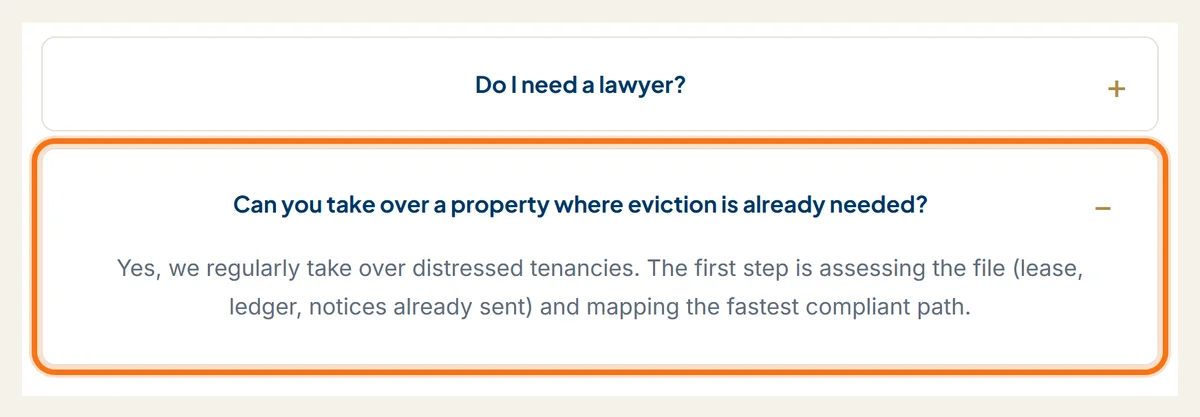
- Problem tenancies mid-stream. Our evictions page says we can take over a problem tenancy inherited from self-management or another manager, and that the first step is assessing the file: lease, ledger and notices already sent.
- The same steps for every tenant. Reminders, late fees applied per the lease, and escalation steps that are the same for every tenant, every time.
- Resolution first, then the notice. A documented payment conversation first, pursued without letting it become stalling; then the notice Texas procedure requires, delivered and documented correctly, with you informed at every step. We are not a law firm and coordinate with a landlord-tenant attorney where appropriate.
- Eviction service is included on Full Service and optional at $7.95 a month on our other plans (price sheet).
Our tenant placement guarantee is written for a tenant we place, not one already living in the home. Whether we appear in justice court, what the eviction service covers, the payment plans we will administer and whether we ask before filing are confirmed in writing before you sign. Every fee you pay is listed in your written agreement. If you have a tenant who is late every month, call 682-593-7033.
Every waiting period in the process, stage by stage with the statute behind it, is in how long an eviction takes in Texas.
The takeaway: A rent problem is fixed with a clean file and a calendar that runs the same way every month; the manager's value is that the calendar never slips because someone likes the tenant.
Questions owners ask
What does a property manager do about a tenant who is late every month?
The manager moves rent to a payment channel with a record, tells the tenant in writing that the lease will be enforced as written, and runs the same calendar every month: a reminder when rent is late, the fee the lease allows once rent is unpaid two full days, and a written notice at the agreed point. Because the tenant was late before, Property Code 24.005(a) allows either a notice to vacate or a notice to pay rent or vacate. Nothing is waived by phone.
My tenant stopped paying. Can a property manager take over?
Yes. A manager can take over mid-lease, rebuild the balance from your lease and payment records, deliver the written notice Property Code 24.005 requires and, if the tenant neither pays nor leaves, prepare the eviction suit in justice court on the terms your agreement sets. No manager can shorten the court's own schedule.
Can a property manager evict a tenant I inherited with the house?
Generally yes, if the lease came to you with the purchase and the manager has your written authority. The manager first confirms the lease terms, the deposit and the real balance, then follows the same notice and filing steps as for any tenant. Have the closing documents and any ledger the seller provided ready. Ask an attorney if the lease or the deposit transfer is unclear.
Will the tenant have to pay late fees from before the manager took over?
Only fees the lease actually provides for, within Property Code 92.019: notice of the fee in a written lease, a reasonable amount and rent unpaid two full days after the due date. Fees an owner never charged, or waived by habit, are usually written off at takeover so the ledger starts clean. Ask an attorney before demanding old fees the tenant may dispute.
Do I have to go to court for an eviction if I have a property manager?
Often not in justice court. Property Code 24.011(a) lets the parties to an eviction suit in justice court be represented by authorized agents who need not be attorneys. If the case is appealed to county court, section 24.011(b) allows an agent only for an owner of multifamily residential property in a nonpayment case, so for a single-family home ask an attorney. This is general information, not legal advice.
What should I give a new property manager about a late-paying tenant?
The signed lease and every addendum, the deposit amount and where it is held, a dated payment history, copies of every notice you sent with proof of delivery, and any text or email where you agreed to late rent or waived a fee. The manager builds the ledger from these, and every later letter and court filing depends on that ledger being right.
Can I offer a tenant who stopped paying a deal to move out?
Yes. An agreed move-out is a written agreement: the move-out date, the condition the home is returned in, how much of the balance you forgive and how the deposit is handled. The deposit rules still apply, including the written description and itemized list of deductions under Property Code 92.104. Have the agreement reviewed before anyone signs. This is general information, not legal advice.
Property management in Keller, North Richland Hills and Fort Worth. How full-service management works in Tarrant County →