Key takeaways
- Two sections of the Texas Property Code do most of the work: 92.014 (belongings and deposit) and 92.0162 (ending the lease).
- They apply when the tenant was the sole occupant. If someone else still lives in the house, the lease governs and the lockout rules still apply.
- Belongings and the deposit go only to the person the tenant designated or someone lawfully entitled, never to whoever arrives first.
- The estate's representative ends the lease with written notice; termination takes effect on the later of the 30th day after notice or the day the belongings are out.
- Rent and damage owed before termination remain a liability of the estate.
What happens when a tenant dies in a Texas rental house? If the tenant lived alone in Fort Worth, Keller or North Richland Hills, Property Code section 92.014 lets you store the belongings and requires you to release them, and the deposit less lawful deductions, to the person the tenant designated or someone lawfully entitled. Section 92.0162 lets the estate's representative end the lease by written notice. Rent owed before that date stays a debt of the estate.
This guide walks through the first days, who may act for the tenant, the belongings, ending the lease, the deposit and money owed, and the one form that makes all of it easier if you ask for it at lease signing.
What Texas law says, step by step
Here is what the Property Code provides when a tenant who was the sole occupant of a rental dies:
| Question | What the statute says | Section |
|---|---|---|
| Who is the first contact? | The person the tenant named for this purpose, if the tenant gave a name, address and phone number | 92.014(a), (b) |
| Can the landlord pack up the belongings? | Yes: the landlord may remove and store all property found in the home | 92.014(c)(1) |
| Who gets the belongings? | The designated person, or any other person lawfully entitled, if they ask before the property is discarded; the landlord may require a signed inventory | 92.014(c)(2), (4) |
| When may unclaimed property be discarded? | After a certified-mail request to the designated person, 30 days from the postmark with no removal, and no one has claimed it | 92.014(c)(5) |
| Who gets the deposit? | The designated person or another person lawfully entitled, less lawful deductions, including the cost of removing and storing the property | 92.014(c)(3) |
| How does the lease end? | The estate's representative gives written notice; effective the later of the 30th day after notice or the day all conditions are met | 92.0162(a), (b) |
| What does the estate still owe? | Delinquent rent and damage beyond normal wear and tear from before termination | 92.0162(d) |
How to read this table: the rows run roughly in the order things happen. A written lease may set a different procedure for the belongings (92.014(d)), so read the lease first; where it is silent, these rules apply.
The first days: the family, the house, and who may go inside
Most owners hear the news from a relative, a neighbor or the police, and the first instinct is to help the family. That is right, and so is going slowly with the keys. Until you know who has authority, the house holds someone else's property and possibly their papers, cash and medication.
- Confirm before you act. Speak with the family member or official who contacted you, and write down who said what, and when.
- Secure the home. Make sure doors and windows are locked. Keep utilities on so the house is protected; who pays for them is a question for the lease.
- Escort every entry. If the tenant signed the statement in 92.014(a), the designated person gets access at a reasonable time in the presence of the landlord or the landlord's agent. Follow that standard for anyone else too.
- Pause marketing. Do not list or show the home until possession is back in your hands.
Section 92.0162(e) protects you here: a landlord or agent who lawfully permits or facilitates the representative's entry is not liable for an act or omission arising from it. The protection is for lawful entry, which is why the next question matters.
Who can act for the tenant: the designated contact, the representative, the heirs
Three kinds of people may come forward, and the statutes treat them differently:
- The person the tenant designated. Section 92.014(a) lets a landlord ask in writing for the name, address and phone number of a person to contact if the tenant dies, plus a signed statement authorizing access, removal of property and refund of the deposit to that person. A tenant may also volunteer it (92.014(b)).
- A representative of the estate. Only this person can end the lease early under 92.0162. The Texas State Law Library explains that the court document establishing an executor's or administrator's authority is called letters testamentary or letters of administration.
- Others lawfully entitled. Section 92.014(c) also allows release to "any other person lawfully entitled." The Law Library describes informal routes, such as a small estate affidavit, a muniment of title or a determination of heirship, that end with a court order heirs can use to collect property.
Ask for the document, keep a copy, and release nothing to a relative who has none. When two family members disagree, hold the property and the deposit and let them, or a court, decide. This is general information, not legal advice; probate questions belong with a Texas probate attorney.
The tenant's belongings: storing, releasing and, last, discarding
Section 92.014(c) gives a clear order for a sole occupant's property:
- You may remove and store it. Photograph each room first, then pack, label and store. The reasonable cost of removing and storing can be deducted from the deposit (92.014(c)(3)).
- Release it on request to the designated person or anyone lawfully entitled, as long as the request comes before the property is discarded. You may require the person removing it to sign an inventory (92.014(c)(4)).
- Discard only after the steps. Mail a written request to remove the property to the designated person by certified mail, return receipt requested. If it is not removed by the 30th day after the postmark and no one has contacted you claiming it, you may discard it (92.014(c)(5)).
Illustrative only: a request postmarked May 1 runs to May 31 before discarding is allowed, and a single call from a relative claiming the property stops it. Two consequences cut both ways: a landlord who knowingly violates 92.014(c) after being furnished a copy of the subchapter is liable to the estate for actual damages (92.014(f)), and a tenant who knowingly refused the designation after receiving a copy leaves the landlord with no responsibility for the property (92.014(e)).
The discard step is written around a designated person. If the tenant never named one, talk to an attorney before throwing anything away. This is different from an ordinary move-out; property left by a living tenant is covered in abandoned property after move-out.
How the lease ends: the estate's 30-day notice under section 92.0162
No section of Property Code chapter 92 says a lease ends automatically when the tenant dies. Section 92.0162 gives the estate a defined way out. The representative of the estate of a tenant who dies before the lease expires, and who was the sole occupant, may terminate the lease and avoid liability for future rent if:
- the representative gives the landlord or the landlord's agent written notice of termination;
- the tenant's property is removed in accordance with 92.014(c) or (d); and
- the representative signs an inventory of the removed property, if the landlord requires one.
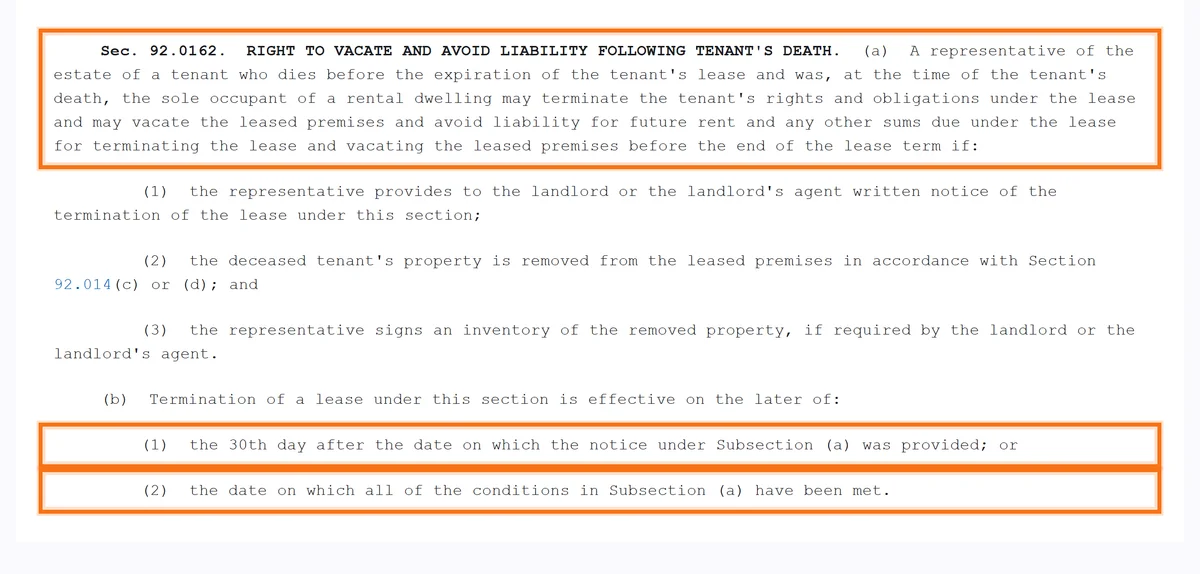
Termination is effective on the later of the 30th day after the notice or the date all conditions are met (92.0162(b)). Illustrative only: notice delivered March 3 with the belongings out and the inventory signed on March 20 takes effect April 2, the 30th day after March 3. If the belongings are not out until April 10, it takes effect April 10.
After receiving the notice, you must give the person who sent it a copy of the written lease on written request (92.0162(c)). How this sits beside other early-termination rights is in lease termination notices in Texas.
When someone else still lives in the house
Sections 92.014(c) and 92.0162 are written for a tenant who was the sole occupant. When a co-tenant, spouse, adult child or roommate still lives there, those procedures do not fit, and the lease governs the people who signed it.
- Do not change the locks. Property Code section 92.0081 bars a landlord from intentionally preventing a tenant from entering except by judicial process, with narrow exceptions.
- Talk to the people still living there. A co-tenant on the lease remains bound by it. Someone who lived there but never signed may want to apply in their own name; screen them against the same written criteria as any applicant.
- Keep the deceased tenant's personal items separate where you can, and release them only to someone with authority, as above.
If no agreement is reached and an occupant has no right to stay, the route is the ordinary notice and eviction process, never self-help. Get legal advice before you start it. This is general information, not legal advice.
The security deposit, unpaid rent and damage
The deposit goes to the designated person or another person lawfully entitled, less lawful deductions, which include the cost of removing and storing the property (92.014(c)(3)). The general deposit rules still frame the deductions: no charge for normal wear and tear, and a written description and itemized list of any deductions (92.104). The usual 30-day refund rule (92.103) is counted from when the tenant surrenders the premises, and with a deceased tenant that date can be unclear, so account for it promptly once the home is back in your hands.
Rent and damage. Section 92.0162(d) keeps the estate liable for delinquent rent and for damage beyond normal wear and tear from before the lease ends. That is a claim against the estate, and the Law Library notes that in probate the debts are paid with court approval. Send a clear written statement to the representative, and see damage or unpaid rent beyond the deposit for the general rules. This is general information, not legal advice.
What to set up at lease signing, before it is ever needed
Nobody likes asking a new tenant who to call if they die, but the statute exists for exactly that. At lease signing:
- Ask in writing for the 92.014(a) designation: a name, address and phone number, and a signed statement authorizing access with you present, removal of property and refund of the deposit to that person.
- Give the tenant a copy of Subchapter A, which shifts responsibility to a tenant who knowingly refuses (92.014(e)).
- Decide whether the lease should set its own procedure for a deceased tenant's property, which 92.014(d) allows.
- Update the contact at every renewal. People move and relationships change.
It turns a hard week for a family into a clear one, and it gives you a person with written authority from day one.
How Perpetual handles leases and move-outs in Fort Worth, Keller and North Richland Hills
Perpetual Property Management is broker-owned, with our office at 5755 Rufe Snow Dr in North Richland Hills, and we manage homes in Keller, North Richland Hills, Fort Worth and nearby. What our site states that bears on this situation:
- Texas-compliant lease documents with the addenda your property needs, not a generic template (leasing and tenant placement).
- A 360-degree condition inspection at every move-in and move-out, so deductions are measured against a documented baseline (inspections and reporting).
- Calls and emails answered within one business day, or that month's fee is credited, subject to the Guarantee Addendum, and 24/7 emergency response on every plan.
- Every fee in your written agreement. If a fee is not in the agreement, you do not pay it.
Our site does not describe a procedure for a tenant's death: whether our lease asks for the 92.014 contact designation or sets its own property procedure, how storage is arranged, and any charge for that work are confirmed in writing before you sign. For a quote on your rental, request a free rental analysis or call 682-593-7033.
The takeaway: Secure the house, find the person the tenant designated or the estate's representative, follow 92.014 for the belongings and deposit, let the representative end the lease under 92.0162, and ask every new tenant for a contact designation.
Questions owners ask
Does a lease end automatically when a tenant dies in Texas?
Property Code chapter 92 does not say so. Section 92.0162 gives the representative of a sole occupant's estate a way to end it: written notice, the belongings removed under section 92.014, and a signed inventory if you require one. Termination is effective on the later of the 30th day after notice or the day those conditions are met. Read the lease too, since it may say more.
Who gets the security deposit when a tenant dies?
Under section 92.014(c)(3), the deposit goes to the person the tenant designated or another person lawfully entitled to it, less lawful deductions, which include the cost of removing and storing the tenant's property. Deductions still cannot cover normal wear and tear, and they are generally itemized in writing under section 92.104.
Can family members take the tenant's belongings?
Only a person the tenant designated or someone lawfully entitled, such as an estate representative with letters testamentary or letters of administration, or an heir with a court order. You may require a signed inventory of what is removed. Releasing property to a relative with no authority is the mistake to avoid.
How long do I have to store a deceased tenant's belongings?
Section 92.014(c)(5) allows discarding only after you mail a written request by certified mail, return receipt requested, to the designated person, 30 days pass after the postmark without removal, and no one has contacted you claiming the property. If the tenant designated no one, get legal advice before discarding anything.
Is the tenant's estate responsible for unpaid rent?
For the period before the lease ends, yes. Section 92.0162(d) says termination does not affect the estate's liability for delinquent unpaid rent or for damage beyond normal wear and tear. Future rent after a proper termination is avoided. The claim is made to the estate's representative.
Can I re-rent the house right away?
Not until possession is back in your hands: the belongings are removed or released under section 92.014, and the lease has ended, by the estate's notice under section 92.0162 or by the lease's own terms. If anyone else still lives there, the lease and the lockout rules in section 92.0081 still apply to them.
What if the tenant did not live alone?
Sections 92.014(c) and 92.0162 are written for a sole occupant. A co-tenant on the lease remains bound by it, and the landlord may not lock out a tenant except by judicial process. Someone who lived there without signing may apply in their own name under your usual criteria.
Property management in Keller, North Richland Hills and Fort Worth. How full-service management works in Tarrant County →