Key takeaways
- An eviction in Texas is a lawsuit in justice court to recover possession; the outcome can be a judgment for the landlord, a judgment for the tenant or a dismissal.
- A screening report line is a pointer; the court record says what actually happened.
- 15 U.S.C. 1681c(a) bars consumer reports from including civil judgments older than seven years, or the statute of limitations if longer.
- The written criteria decide, and Texas law requires them to be made available with the application (Property Code 92.3515).
- Our published causes for rejection include "Eviction by a previous landlord", applied to every applicant without exceptions.
A property manager evaluates an applicant with a previous eviction by finding out what the record actually is, a judgment for possession or a filing that was dismissed, checking what the consumer report may lawfully include, and applying the written criteria the applicant saw before paying the fee. The same rule applies to every applicant. For owners in Fort Worth, Keller and North Richland Hills, that means deciding before listing which records disqualify, and verifying every record against it.
Below: a table of what an applicant's file can show, what an eviction record is in Texas, filing versus judgment, what a consumer report may contain, how inconsistent rental history is checked, and how our published criteria treat each item. The wider criteria framework is in tenant screening criteria in Texas.
What the applicant shows, what gets verified, how the criteria treat it
Here are the eviction and rental-history items that turn up in an application, what a manager verifies for each, and how our published rental criteria treat them:
| What the applicant's file shows | What is verified | How our published criteria treat it |
|---|---|---|
| A judgment for possession for a previous landlord | The court record: case number, date, outcome, who was named as defendant | Listed cause for rejection: "Eviction by a previous landlord" |
| An eviction case that was filed and then dismissed | The court record showing the dismissal; the previous landlord's reference | Not addressed on the criteria page; ask us (see the last section) |
| Money still owed to a previous landlord | The previous landlord's ledger or reference; any money judgment | Listed cause: "Outstanding debt or unpaid charges to a previous landlord" |
| Late payments in recent tenancies | Rental history verification with previous landlords | Listed cause: "Excessive late rent payments in the last 2 years" |
| Gaps, short stays or landlords who cannot be reached | The 3 years of residential history and the rental references the application asks for | Applicants must provide 3 years of residential history and rental references; how a gap is weighed is not stated: ask us |
| A past eviction left off the application | The applicant's answers compared with reports and court records | Listed cause: "Falsification of any kind on the rental application" |
How to read this table: the middle column is the work, and the right column is the decision, taken word for word from our criteria page. Where the criteria page says nothing, we do not improvise for one applicant; the answer is set before listing and applied to everyone.
What an eviction record is in Texas
In Texas, an eviction is a lawsuit to recover possession of a home, heard in a justice court. Texas Rule of Civil Procedure 510.1(a) says Rule 510 "applies to a lawsuit to recover possession of real property under Chapter 24 of the Texas Property Code, often by a landlord against a tenant," and that a claim for unpaid rent may be joined to it.
The outcome is what matters for screening. Under Rule 510.18(d), a judgment for the landlord is "for possession of the premises, costs, delinquent rent as of the date of entry of judgment, if any, and attorney fees if recoverable by law." Under 510.18(e), a judgment for the tenant is for costs and attorney fees, if recoverable, against the landlord. A case can also end without a judgment, for example when it is dismissed.
So the first step is not a decision; it is a lookup. The manager finds the case, reads the outcome, the date and any amount, and checks who was named. Then the applicant's account is heard. The applicant's version is a lead, not evidence, until a document or a third party confirms it.
Filing, dismissal, judgment: what the record actually shows
Eviction records fall into a few groups, and written criteria should say how each is treated:
- Judgment for possession. The court ruled for the landlord and ordered possession. This is what "eviction by a previous landlord" most plainly describes.
- Filed and dismissed. The landlord filed and the case ended without a judgment for possession.
- Judgment for the tenant. The court ruled against the landlord.
- A case against someone else in the household. A roommate or former partner was the named defendant. The record follows the name, so check whose name it is.
A report that only says a case was found is a prompt to go and look. Deciding on the line alone, without the outcome, means deciding on less than the record shows, in either direction.
What a consumer report may show, and for how long
When a screening report comes from a consumer reporting agency, the Fair Credit Reporting Act limits what it may contain. Under 15 U.S.C. 1681c(a), no consumer reporting agency may include "civil suits, civil judgments, and records of arrest that, from date of entry, antedate the report by more than seven years or until the governing statute of limitations has expired, whichever is the longer period." Paragraph (5) adds "any other adverse item of information, other than records of convictions of crimes which antedates the report by more than seven years."
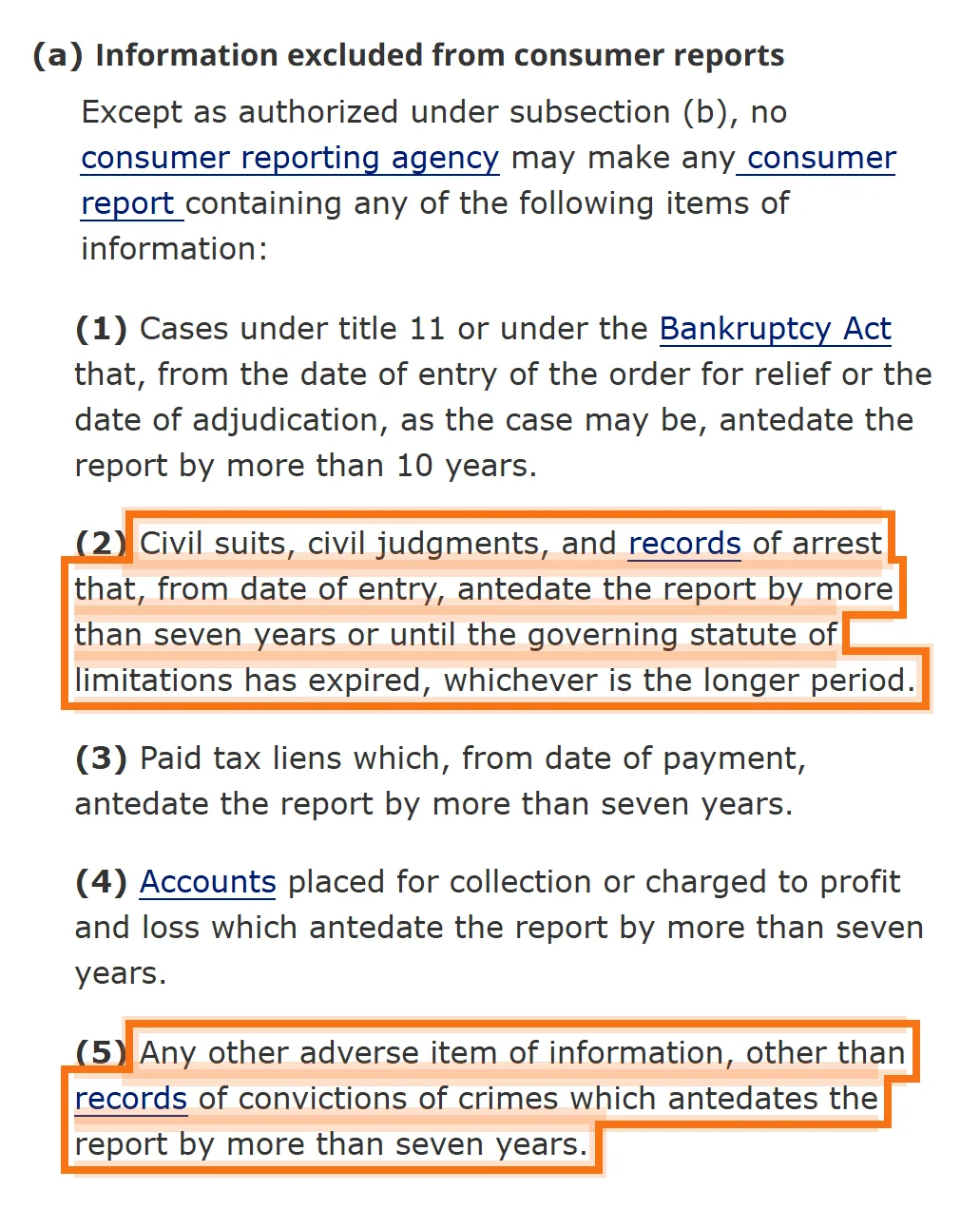
Two practical points follow. First, an old case may simply not appear on a report, so a clean report is not proof that no case exists, and an applicant's own answers matter. Second, a report line is a pointer, not the outcome: the court's record says whether the case ended in a judgment or a dismissal.
If a decision against the applicant is based "in whole or in part on any information contained in a consumer report," 15 U.S.C. 1681m(a) requires an adverse action notice: the reporting agency's name, address and telephone number, a statement that the agency "did not make the decision," and notice of the right to a free copy within 60 days and to dispute the report. This is general information, not legal advice.
The written rule decides, not the story
What makes the evaluation consistent is that the rule exists before the application does. Texas Property Code 92.3515(a) requires a landlord, when giving out a rental application, to make available printed notice of the "tenant selection criteria and the grounds for which the rental application may be denied," and "previous rental history" is one of the grounds the statute names. The applicant signs an acknowledgment (92.3515(b)).
Our published criteria list nine causes for rejection, and the first is "Eviction by a previous landlord." The second is "Outstanding debt or unpaid charges to a previous landlord." They are applied to every applicant the same way: our screening page says "You set the standards with us; we apply them without exceptions."
For any owner, the questions to settle in writing before listing are the same: which outcomes count, how far back, and whether money still owed is a separate cause. The method behind the rest of a screening is in how tenant screening works.
What an applicant can document, and what it cannot change
When an applicant has a record, these are the documents that can be verified:
- The court's own record showing a dismissal or a judgment for the tenant.
- Proof that a judgment or balance was paid: a receipt or a written payoff from the previous landlord.
- A reference from a landlord for a tenancy that began after the case.
- Verified current income and employment, through the same checks as any applicant.
These documents establish what the record is. They do not rewrite the criteria. If the written criteria make an outcome a cause for rejection, a sympathetic explanation, a friend's word, or an offer of a larger deposit or several months of rent in advance does not change that, and we do not promise exceptions. Whether a co-signer or extra deposit is accepted at all is not stated on our criteria page; ask us. How managers check income and employment is in how property managers verify an applicant's income.
Inconsistent rental history: the other half of the question
Owners often ask about a prior eviction and inconsistent rental history together, because the two show up the same way: a tenancy that cannot be confirmed. Common patterns:
- A gap. Months with no address on the application.
- Many short stays. Several addresses in a short period.
- Unreachable landlords. A reference that never answers, or a "landlord" who turns out to be a relative.
- Mismatches. Dates or addresses on the application that differ from the reports.
Our application asks for 3 years of residential history and rental references, and the screening includes rental history verification. A gap is a question to ask and document, not an assumption. A deliberate omission is different: "Falsification of any kind on the rental application" is a listed cause for rejection. The deciding question for an owner is the same as for evictions: was the rule written before the applicant applied, and was it applied the same way to everyone?
How Perpetual handles a previous eviction
What our site states, and nothing beyond it. Our rental criteria page lists these causes for rejection, word for word:
- Eviction by a previous landlord
- Outstanding debt or unpaid charges to a previous landlord
- Excessive late rent payments in the last 2 years
- Insufficient or unverifiable income
- Excessive delinquent credit accounts
- Excessive unpaid utility bills
- Utilities cannot be placed in a tenant's name
- Bankruptcy within the last year that has not been discharged or dismissed
- Falsification of any kind on the rental application
The application includes a credit history evaluation, rental history verification, employment and income verification, and a criminal background check on all applicants, at $60.00 per applicant 18 or older. Any denied or canceled applications are non-refundable. Our tenant screening page says: "You set the standards with us; we apply them without exceptions."
The criteria page does not say how a dismissed filing, a judgment for the tenant or the age of a case is treated. For your house, that is set out in the written criteria or confirmed in writing; ask us before listing. To talk it through, call 682-593-7033.

The takeaway: Treat a previous eviction as a record to verify: find the court outcome, know what a consumer report may show, and let the written criteria the applicant saw before applying decide, the same way for everyone.
Questions owners ask
How long does an eviction stay on a tenant's screening report?
15 U.S.C. 1681c(a)(2) bars a consumer report from including civil suits and civil judgments older than seven years from the date of entry, or until the governing statute of limitations has expired, whichever is longer. Other adverse items are limited to seven years by 1681c(a)(5). The court's own record is a separate source, so a manager reads the report as a pointer and checks the outcome there.
Can a landlord deny an applicant for an eviction that was dismissed?
A landlord should deny only on grounds in the written selection criteria made available with the application, as Texas Property Code 92.3515 requires. Our criteria list "Eviction by a previous landlord" as a cause for rejection, but do not say how a dismissed filing is treated; for your house that is set before listing, in writing. Ask us.
What if the eviction happened during a job loss and the balance was paid?
The documents still matter: proof the balance was paid, a later landlord's reference and verified current income establish what the record is. They do not change the written criteria. Our criteria list "Eviction by a previous landlord" and "Outstanding debt or unpaid charges to a previous landlord" as causes for rejection, and we apply the criteria without exceptions.
Do I have to tell an applicant why they were denied?
If the decision is based in whole or in part on a consumer report, 15 U.S.C. 1681m(a) requires notice of the adverse action, the reporting agency's name, address and telephone number, a statement that the agency did not make the decision, and notice of the right to a free copy within 60 days and to dispute it. The reason given should match the written criteria.
How should a manager evaluate inconsistent rental history?
By verifying it against what the application asks for. Ours asks for 3 years of residential history and rental references, and the screening includes rental history verification. Gaps, short stays and unreachable references are questions to document. A deliberate omission is different: "Falsification of any kind on the rental application" is one of our published causes for rejection.
Does Perpetual approve applicants who have a past eviction?
Our published rental criteria list "Eviction by a previous landlord" as a cause for rejection, and our screening page says we apply the criteria without exceptions. The criteria page does not address dismissed filings or the age of a case, so ask us before you apply or, as an owner, before the house is listed.
Related services
Property management in Keller, North Richland Hills and Fort Worth. How full-service management works in Tarrant County →