Key takeaways
- A manager can run the whole rental while you deploy. The planning is about decisions you cannot make from where you will be.
- Set a repair spending limit, and name in writing who approves anything above it when you cannot be reached.
- A Texas durable power of attorney must meet Estates Code 751.0021; a military power of attorney is valid in Texas under 751.0023(b)(2).
- The SCRA (50 U.S.C. 3953) limits foreclosure during service and for one year after, but only on a mortgage taken out before your service began.
- Tell your insurance company the house will be rented. TDI warns that most companies stop coverage after 60 days of vacancy.
Can a property manager look after my rental while I'm deployed? Yes. For a house in Fort Worth, Keller or North Richland Hills, a manager handles the tenant, rent, repairs, inspections and renewals for the whole deployment. The part that needs work before you leave is the fact that you may be unreachable for weeks: who approves a large repair, who signs if a document needs your signature, and how the house stays insured.
Below: a table of who decides what while you are gone, the Texas power of attorney rules, the federal mortgage protection for service members, insurance, the monthly payout, and how to time the lease for your return.
Who decides what while you are deployed
Here is each decision a rental produces during a deployment, who makes it on a Perpetual-managed home as our site describes, and what you should settle in writing before you leave:
| Decision | Who makes it | Settle before you leave |
|---|---|---|
| Routine repair under your limit | We do: repairs under your pre-approved spending limit get fixed fast | The dollar limit, in the management agreement |
| Repair over your limit | You: it comes to you with a description, photos and a recommendation | Who approves it when you cannot answer |
| Emergency (active leak, no AC in extreme heat, no heat in winter) | Our 24/7 emergency process; every plan includes 24/7 emergency response | How you want to hear about it afterward |
| Lease renewal or rent change | You: we bring a recommendation with the market comps, and the decision is always yours | Whether you will be home when the lease ends |
| Eviction filing | You or the person you named: eviction service is included on Full Service and $7.95 a month on the other plans | Who may approve a filing |
| Signing a deed, a refinance or anything recorded | You, or an agent under a power of attorney | A durable power of attorney, recorded if Estates Code 751.151 requires it |
How to read this table: the first and third rows run without you. Everything else needs a yes from someone. If you will be out of contact, the gap is the second, fourth and fifth rows, so name the person who answers for you and put their name in the agreement. The last row is the only one that needs a legal document rather than a phone call.
Why a deployment is different from an ordinary move
An owner who moves to another state can still answer an email the same day. A deployed service member may be out of contact for long stretches, on a schedule they do not control. The arrangement has to work on silence, not on a slow reply.
That means two things. First, the manager needs a spending limit high enough that routine work never waits on you. Second, someone other than you must be able to say yes to what sits above that limit. The rest is ordinary management: the same rent collection, repairs and inspections any out-of-state owner gets. If the house was your home until now, start with converting your home to a rental for the mortgage, insurance and tax points.
Name an alternate, and decide whether you need a power of attorney
The person who decides for you can be a spouse, a parent, a sibling or a friend you trust. Write down what they may approve, such as repairs above your limit up to a set amount, a renewal at the recommended rent, or an eviction filing, and give the manager their contact details. Talk it through with them before you leave.
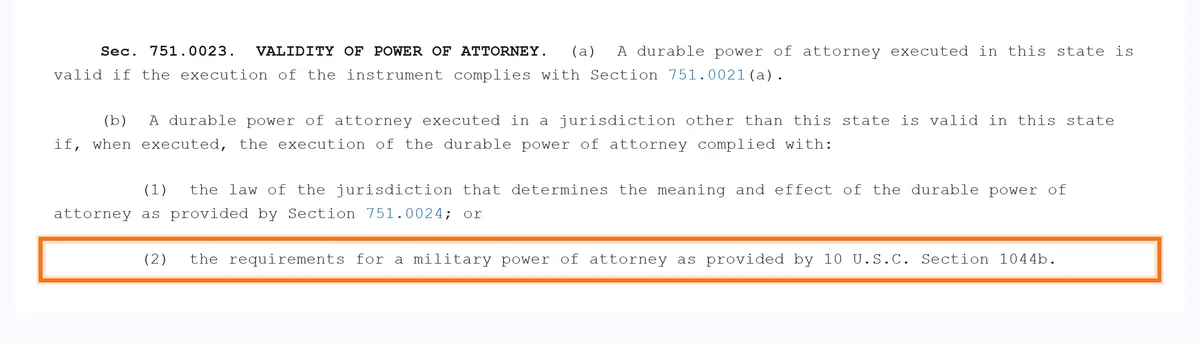
Approving a repair by phone needs no legal document. Signing for you does. A Texas durable power of attorney must be in writing, signed, contain durability language (for example, that it is not affected by your later disability or incapacity), and be acknowledged before an officer such as a notary (Estates Code 751.0021). Section 751.0023(b)(2) adds that one executed under the federal rules for a military power of attorney is valid in Texas.
If your agent may need to sign a deed, a deed of trust or another instrument that gets recorded, Estates Code 751.151 requires the power of attorney itself to be recorded with the county clerk where the house sits, no later than the 30th day after that instrument is filed. Ask a military legal assistance office or a Texas attorney which form fits. This is general information, not legal advice.
The pre-deployment checklist
Work through this list in the weeks before you report, not from the other side of the world:
- Sign the management agreement with a repair spending limit you are comfortable leaving in place for months.
- Name your alternate decision-maker, with what they may approve, and give the manager their phone and email.
- Sign a power of attorney if anyone may need to sign for you, and give the manager a copy.
- Tell your insurance company the house will be rented and get the answer in writing.
- Put the mortgage, HOA dues and any insurance or tax payments you make directly on autopay from the account that receives your payout.
- Leave a cushion in that account for a month when a repair lowers the payout.
- Hand over keys, garage remotes, alarm codes, appliance manuals and the HOA rules.
- Decide what should happen when the lease ends, so a renewal does not wait on you.
- Check that your owner portal login works on your phone.
If the house is your current home, book the move-out photos and the make-ready for the day you leave, not the week after.
What runs without you: rent, repairs, inspections
Our site describes the out-of-state owner's view this way: portal access, photo inspections and statements mean you see everything from anywhere. In practice, for a deployed owner:
- Rent. Tenants pay online through the tenant portal. Late rent follows a documented process: reminders, late fees per the lease, and escalation steps that are the same for every tenant, every time.
- Repairs. Tenants report issues through their portal. Repairs under your pre-approved limit get fixed fast; anything larger comes with a description, photos and a recommendation. Every completed repair over $500 gets photo or video proof in your portal, and the original invoice is always there.
- Inspections. Every plan includes an annual property inspection, with photo reports to the portal. The in-tenancy schedule is set in your management agreement.
- Payout. Rent we collect is disbursed to you by the 10th of each month, or that month's management fee is waived.
Read repair invoices and photos for owners for what each record shows.
Your mortgage, the payout and the SCRA
Your payout is the rent minus the management fee and any repairs that month, so it moves. Assume, as an example, rent of $2,000 on the Standard plan (9% management fee, 4.9% maintenance coordination on the vendor's invoice) and one $300 repair. The fee is $180 and the coordination charge is $14.70, so the payout is $2,000 minus $180, $300 and $14.70, or $1,505.30. In a month with no repair it would be $1,820. Illustrative only, not a quote. Your mortgage autopay has to clear in both months, which is what the cushion is for.
The federal Servicemembers Civil Relief Act protects a deployed owner as a borrower in one situation. Under 50 U.S.C. 3953, if your mortgage was taken out before your period of military service, a court in an action to enforce it filed during your service or within one year after may stay the proceedings or adjust the obligation, and must on your application when service materially affects your ability to pay; and a sale or foreclosure during service or within one year after is not valid without a court order or an agreement under 50 U.S.C. 3918. A mortgage taken out while already serving is outside that section. Ask your lender and a legal assistance office what applies to yours.
Give your tax preparer access to your statements: our rent-collection page says you can share access or documents with your CPA directly. General information, not legal or tax advice.
Insurance while you are deployed: the house and the tenant's policy
The Texas Department of Insurance home insurance guide says a company may nonrenew a policy when a house is vacant for 60 days or more, and that most companies stop coverage after a vacancy that long, though usually not liability coverage. A house sitting empty while you wait for a tenant, or between tenants during a long deployment, is the case to plan for. TDI's advice is to talk to your company if you plan to be out of the house for an extended time.
Tell your insurer, in writing, that the house will be rented while you are deployed, and get its answer in writing before the tenant moves in. If the house is changing from your home to a rental, read landlord insurance vs homeowners insurance and what landlord insurance you need before renting out a house. Leave a copy of the declarations page with your manager and the person you named, so a claim can start without you.
Renters insurance during a military deployment is the tenant's question, not the owner's: TDI says renters insurance covers the renter's clothes, furniture and other belongings and does not pay to fix the house, which is the building owner's policy. This is general information, not insurance advice.
Coming home: moving back in or keeping the tenant
Decide before you leave what you want when the deployment ends, because the lease term has to match it. If you plan to move back in, set a lease that ends after your expected return, not on it, so a change in orders does not leave you without a place to live. If you plan to keep renting, our renewal work starts 120 days before the lease ends, the conversations with the tenant typically 60 to 90 days out, and the decision is always yours, or your named alternate's if you cannot answer.
A signed lease binds both sides. If you come home early, the tenant has a right to stay until the term ends unless the lease says otherwise, so build in some slack rather than counting on an early exit. What a nonrenewal notice needs is in lease termination notices in Texas.
How Perpetual handles this
Perpetual Property Management is broker-owned, with our office in North Richland Hills, and we manage homes in Keller, North Richland Hills, Fort Worth and nearby. What our site states, and what it means for a deployed owner:
- Spending limit. Agreed with you in advance; routine items get fixed fast, larger items come to you with a recommendation.
- Emergencies. A 24/7 process on every plan.
- Records. Monthly statements, documents and disbursement history in the AppFolio owner portal; photo reports after inspections; the original invoice for every repair.
- Payout. By the 10th of each month, or that month's management fee is waived. Our guarantees are subject to the terms and exclusions in our Guarantee Addendum.
- Fees. Every number is confirmed in writing before you sign, and if a fee is not in the agreement, you do not pay it (pricing).
How your named alternate is recorded, what they may approve and how we reach them when you are out of contact are confirmed in writing before you sign. If you have orders and a house to rent, see our full-service management page, then call 682-593-7033 early enough to finish the setup before you report.
The takeaway: A manager can carry your rental through a deployment when the spending limit, the person who decides in your absence, the power of attorney and the insurance are settled in writing before you report.
Questions owners ask
Do I need a power of attorney for my property manager while deployed?
For routine management, the management agreement sets what the manager may do as your agent, so check it. A power of attorney is for anything that needs your own signature while you are away, such as a deed or a refinance. In Texas a durable power of attorney must meet Estates Code 751.0021, and a military power of attorney is valid under 751.0023(b)(2). Ask a legal assistance office or a Texas attorney which one fits.
What if my tenant stops paying while I am deployed?
The late process runs the same way it would for any owner: reminders, late fees per the lease, then documented escalation steps that are the same for every tenant. You hear quickly, not at month-end. An eviction filing is a decision for you or the person you named, so put that authority in writing before you leave. Eviction service is included on Full Service and optional at $7.95 a month on the other plans.
Can I get my house back when I return from deployment?
Yes, if the lease term was set with your return in mind. A fixed-term lease ends on its date, with the nonrenewal notice the lease requires. A tenant with months left on a signed lease does not have to leave early because you came home early, unless the lease says otherwise, so end the term after your expected return date rather than on it.
Does renting my home during deployment affect my insurance?
It can. Tell your insurance company the house will be rented and get its answer in writing before the tenant moves in. The Texas Department of Insurance guide warns that most companies stop coverage if a house is vacant for 60 days or more, though usually not liability coverage, so a long empty stretch during a deployment needs a call to your company. General information, not insurance advice.
Does the SCRA protect my rental's mortgage while I am deployed?
Only a mortgage taken out before your period of military service. For that kind of obligation, 50 U.S.C. 3953 lets a court stay a foreclosure action or adjust the obligation when service materially affects your ability to pay, and makes a sale or foreclosure during service or within one year after invalid without a court order or an agreement under 50 U.S.C. 3918. Ask your lender and a legal assistance office.
Do I need renters insurance during a military deployment?
If you are the owner, the house is covered by your own policy, not renters insurance. Renters insurance is the tenant's policy: the Texas Department of Insurance says it covers the renter's clothes, furniture and other belongings and does not pay to fix the house. A service member renting a place should ask an agent or read TDI's home insurance guide.
Property management in Keller, North Richland Hills and Fort Worth. How full-service management works in Tarrant County →