Key takeaways
- Compare net income at a realistic number of booked nights, not a nightly rate times thirty.
- Fort Worth's page says short-term rentals (1 to 29 days) are not allowed in its residential districts, and legal ones must register and pay hotel tax.
- The Comptroller says the 6% state hotel occupancy tax applies to houses rented for less than 30 consecutive days.
- HOA restrictions and insurance can end the question before the numbers do.
- We manage long-term rentals only.
Is a long-term or short-term rental better for a house in Texas? Compare the net, not the gross, and check the rules first. For a house in Fort Worth, Keller or North Richland Hills, a twelve-month lease gives steady rent with a tenant who pays the utilities; a short-term rental can gross more but pays its own cleaning, utilities, furnishings and fees, collects hotel tax, and may not be permitted at your address.
Below: a side-by-side table, a net-income example added up twice, the city and hotel-tax rules as the official pages state them today, HOA and insurance checks, and a decision order.
Long-term vs. short-term rental, side by side
Here is how the two models differ on the points that decide the net, with the official source where a rule is involved:
| Point | Long-term lease (12 months) | Short-term rental (29 days or less) |
|---|---|---|
| Who pays utilities | Usually the tenant, per the lease | The owner, every month |
| State hotel occupancy tax | Not applicable to a house leased for more than 30 consecutive days (Comptroller) | 6% of the room price, collected from guests, plus any local hotel tax (Comptroller) |
| Fort Worth rules | No short-term rental registration needed | Allowed only in certain non-residential districts; register before listing, $150 first-time fee, $100 annual renewal (City of Fort Worth) |
| Cleaning and turnover | Once every lease, usually a year or more | After every stay |
| Furnishings | Usually none | Owner buys and replaces |
| Insurance | Landlord policy, written mainly for long-term leases (TDI) | Ask your insurer about coverage for paying guests (TDI) |
| Owner time | Light with a manager | Daily: messages, bookings, cleaners, restocking |
How to read this table: the right-hand column is a business with its own tax account and, in Fort Worth, its own registration and zoning test. If any rule row rules out your address, the income rows do not matter. Rules are as the official pages read in November 2026; confirm before you act.
Net income compared, on illustrative numbers
A nightly rate times thirty is not income. The comparison that matters is net income before the costs both models share (mortgage, property tax, the owner's basic insurance), at a realistic number of booked nights. Every number below is illustrative only, not a quote and not market data; use your own.
Long-term. Rent of $2,200 a month is $2,200 x 12 = $26,400 a year. Allow $1,100 a year for vacancy (one empty month every two years) and $1,500 for repairs and turnover. Net: $26,400 - $1,100 - $1,500 = $23,800.
Short-term at 15 booked nights a month. 15 x 12 = 180 nights at $200 = $36,000. Costs: cleaning after 60 three-night stays at $90 = $5,400; utilities and internet $350 x 12 = $4,200; a platform host fee of 3% = $1,080 (use your platform's actual terms); supplies $1,200; furnishing replacement $2,000; extra insurance $800; Fort Worth registration $150. Total costs $14,830. Net: $36,000 - $14,830 = $21,170.
At 18 booked nights. 216 nights x $200 = $43,200. Cleaning rises to 72 stays x $90 = $6,480 and the fee to $1,296; total costs $16,126. Net: $27,074. The answer turns on booked nights, and on your own hours, which are not in either figure.
Hours, wear and the work of a short stay
A long-term rental, well managed, asks a few hours a month: rent, the occasional repair, an annual inspection, a renewal conversation once a year. With a manager, almost none of those hours are yours.
A short-term rental is a hospitality business. Someone answers inquiries quickly, manages the calendar and pricing, books a cleaner after every stay, restocks supplies, helps the guest who cannot get in at 11 p.m., and resets the house between a Sunday checkout and a Monday arrival. Owners who do it themselves describe a part-time job; owners who hire it out pay a share of revenue for that work.
Wear follows the same pattern. A long-term tenant lives in the house and wear is gradual. A short-stay house is reset dozens of times a year, linens and kitchenware are consumables, and furniture, floors and fixtures see far more use, so budget for a periodic refurbishment as well as cleaning. How passive a rental really is describes the long-term version.
City rules: Fort Worth, Keller, North Richland Hills
Short-term rentals are regulated city by city, so the first question is whether one is allowed at your address at all.
Fort Worth. The city's short-term rentals page, read in November 2026, defines a short-term rental as a residential unit rented to guests for 1 to 29 days. It says they are allowed in all mixed-use and most form-based, commercial and industrial zoning districts, and are not allowed in the residential districts listed as A-#, AR, B, R1, R2, CR, C, D and UR. Legal ones must register with the city before the property is listed, renew every year, upload a zoning confirmation, display the registration in the property and pay the hotel occupancy tax. The first-time fee is $150 and the annual renewal is $100.
Keller and North Richland Hills. This guide does not state these cities' short-term rental rules; confirm with the city. Ask the city: call the planning or development office, ask whether a short-term rental is permitted at your specific address and under what conditions, and get the answer in writing.
For any other city, do the same before furnishing or listing. The guide to city rental registration in Tarrant County covers the long-term side.
Texas hotel occupancy tax: what the Comptroller says
The Texas Comptroller's hotel occupancy tax page says the state tax applies not only to hotels but also to "condominiums, apartments and houses", and that persons leasing their houses must collect the tax from their customers in the same way a hotel does.
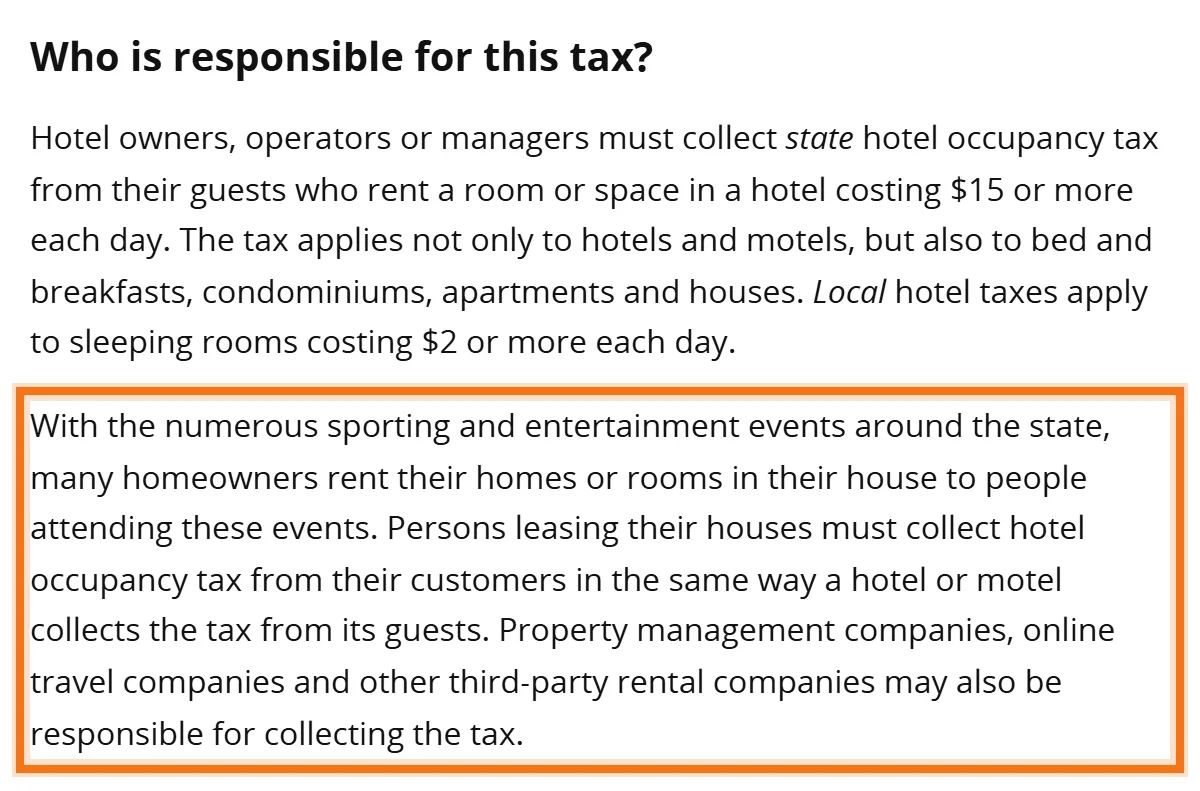
What else the Comptroller's pages state:
- The state rate is 6 percent of the cost of a room; cities and certain counties and districts may add a local hotel tax, which the local authority collects.
- The tax covers houses rented for less than 30 consecutive days, and does not apply to houses leased for more than 30 consecutive days.
- A short-term rental platform that has agreed to collect state tax for the owner collects and remits it. For bookings on your own website or a platform that does not collect, you collect and remit it, and you should contact the county and city about local tax.
- Monthly returns are due on the 20th of the following month.
The tax is collected from guests on top of the rate, so it is not your income: in the example below, 6% of $36,000 is $2,160 that passes through to the state. Fort Worth's page adds that legal short-term rentals must register and pay the hotel occupancy tax. This is general information, not tax advice; a CPA who handles short-term rentals can confirm how income tax treats the activity.
HOA and deed restrictions can end the question
Many subdivisions have deed restrictions or HOA rules that set a minimum lease term or bar transient or hotel-type use. They apply regardless of what the city allows, and an association that finds a nightly rental in a restricted subdivision can send violation notices and fines.
Read the declaration itself, not just a rules summary, and look for the sections on leasing, use and occupancy. If the wording is unclear, ask the association in writing whether stays shorter than a stated term are allowed, and keep the reply. Long-term leases face HOA rules too, such as leasing limits and tenant registration, but are rarely barred outright. HOA rules for rental property in Texas covers what to check for a standard lease, and how to check whether your HOA allows renting walks through the documents.
Insurance: a landlord policy is written for leases
The Texas Department of Insurance says homeowners insurance probably won't cover the costs if someone else gets hurt or causes damage when you rent your home to short-term visitors, and that landlord insurance "is mainly for traditional, long-term leases, and may not be appropriate for short-term rentals." It suggests asking your insurance company whether to add coverage for paying guests, and notes that some home-share websites and apps offer coverage you can buy.
So before comparing numbers, get a written quote for the short-term coverage your insurer would require, read the exclusions of any platform coverage, and put the difference in the net-income example. For a long-term rental, the landlord insurance guide explains the baseline. This is general information, not insurance advice.
Your mortgage and income tax: questions to ask first
Two conversations to have before the first booking. First, your mortgage: some residential loans contain occupancy or use provisions, so read your loan documents and ask your servicer whether short-term use is allowed. Second, income tax: how short-stay income is treated can depend on the average length of stay and the services you provide, so ask a CPA who handles rentals before you start, not at year end.
This section is general information, not legal, tax or lending advice.
The middle option: furnished stays of a month or more
Between a twelve-month lease and nightly stays sits the furnished rental for a month or more, for relocation, medical or insurance-displacement tenants. Two official lines mark it off: Fort Worth defines a short-term rental as 1 to 29 days, and the Comptroller says hotel tax does not apply to houses leased for more than 30 consecutive days. A stay of exactly 30 days sits on the edge of those two definitions, so confirm with the city and the Comptroller before relying on it.
A mid-term rental is less work than nightly stays and more than an annual lease, and it pays only where that tenant demand exists. Should you furnish your rental covers whether your home fits. HOA rules may still set a minimum lease term.
A decision order for a North Texas owner
Work through these in order and stop at the first no:
- Does your city allow a short-term rental at your address, confirmed in writing? In Fort Worth, check the zoning district first.
- Do your deed restrictions and HOA allow stays that short?
- Will your insurer cover paying guests, and is your lender comfortable?
- Are you set up to collect and remit hotel occupancy tax, state and local?
- At a realistic number of booked nights, measured from comparable listings over a full year, does the short-term net clearly beat the long-term net?
- Do you want to run, or pay someone to run, a daily hospitality operation?
A no at any step points to the twelve-month lease. Our leasing service is built for that model, and a free rental analysis gives you the long-term number to compare against.
How Perpetual fits: long-term rentals only
Perpetual Property Management is broker-owned, with our office in North Richland Hills, and we manage rentals in Keller, North Richland Hills, Fort Worth and nearby. Our North Richland Hills page says it plainly: we manage long-term residential rentals, twelve-month leases and renewals for single-family homes, duplexes and small multifamily, and we do not manage short-term or vacation rentals.
For the long-term side of the comparison, what our site states:
- The rent: a free rental analysis with a rent range from leased comparables and a written management quote.
- The cost: management at 7% (Investor Special, 5 or more units), 9% (Standard) or 10% (Full Service) of monthly rent, with tenant placement at 50% or 75% of one month's rent depending on the plan.
- The lease: current Texas-compliant lease documents with the addenda the property needs, and screening of every adult applicant against written criteria.
Exactly which lease clauses cover subletting and short stays in your house are confirmed in writing before you sign. If a tenant lists your house on a short-stay platform, when your tenant sublets or lists the house on Airbnb covers what to do. To see what a twelve-month lease should bring, request a free rental analysis or call 682-593-7033.
The takeaway: Confirm the city, HOA and insurance answers first, then compare net income at realistic booked nights and hours per month; for many houses the twelve-month lease wins on both.
Questions owners ask
Do short-term rentals make more money than long-term rentals in Texas?
They can gross more, but the net depends on booked nights, cleaning, utilities, furnishings, fees, insurance and your time. In the illustrative example, a $2,200 lease nets $23,800 a year, while a short-term rental at $200 a night nets $21,170 at 15 booked nights a month and $27,074 at 18. Run it on your own numbers, after checking the rules.
Are short-term rentals allowed in North Texas cities?
It depends on the city and the zoning district. Fort Worth's page says short-term rentals are not allowed in its residential districts and must register and pay hotel tax where they are allowed. This guide does not state Keller's or North Richland Hills' rules; confirm with those cities directly. Confirm with your city for your specific address before furnishing or listing.
Can my HOA stop me from running a short-term rental?
Often, yes. Many deed restrictions and HOA rules set a minimum lease term or bar transient use, and they apply regardless of city rules. Read the declaration's leasing and use sections, ask the association in writing if the wording is unclear, and keep the reply. A nightly rental in a restricted subdivision can draw violation notices and fines.
Does landlord insurance cover a short-term rental?
Often not. The Texas Department of Insurance says landlord insurance is mainly for traditional, long-term leases and may not be appropriate for short-term rentals, and that homeowners insurance probably won't cover injuries or damage caused by short-term visitors. Ask your insurer about coverage for paying guests and get the answer in writing. This is general information, not insurance advice.
What is a mid-term rental and is it a good middle option?
A furnished home rented for a month or more, usually to relocation, medical or insurance-displacement tenants. Fort Worth defines short-term rentals as 1 to 29 days, and the Comptroller says hotel tax does not apply to houses leased for more than 30 consecutive days. It is more work than an annual lease and works only where that demand exists.
Do I have to collect hotel tax on a short-term rental in Texas?
The Comptroller says persons leasing their houses must collect hotel occupancy tax from their customers in the same way a hotel does; the state rate is 6 percent, and local taxes can apply. A platform that has agreed to collect state tax for you does so on bookings it handles; for your own website or a non-collecting platform, you collect and remit it.
Does Perpetual manage short-term or vacation rentals?
No. We manage long-term residential rentals: twelve-month leases and renewals for single-family homes, duplexes and small multifamily in Keller, North Richland Hills, Fort Worth and nearby. If you are weighing the two, a free rental analysis gives you the long-term rent and a written management quote to compare with your short-term numbers.
Related services
Property management in Keller, North Richland Hills and Fort Worth. How full-service management works in Tarrant County →