
Key takeaways
- Finding the tenant replaces marketing and showings; the application, lease, deposit, move-in record and keys still have to be done.
- Your tenant applies under the same written criteria as anyone else.
- Managers price this differently: full fee, a reduced owner-sourced fee, or a per-step charge. Read your agreement for the clause.
- A tenant at below-market rent can cost more over a year than the fee you saved.
- Our published placement fee is 50% of one month's rent on Full Service and Investor Special and 75% on Standard; any owner-sourced terms are confirmed in writing.
If you find the tenant yourself, the leasing fee should reflect what the manager no longer does: marketing and showings. What it still covers is the part that protects you: the application under written criteria, the lease, the deposit, the move-in condition record and the keys. Whether that means the full fee, a reduced fee or a per-step charge depends on your management agreement. For owners in Fort Worth, Keller and North Richland Hills, settle the number in writing before your tenant applies.
This guide lists what still has to happen, how managers price it, the arithmetic of a reduced fee, and our own published fee. What a full leasing fee covers is in leasing fees explained.
What still has to happen when you find the tenant
Here are the steps a lease-up still needs after you have found the person, what each involves and why it still matters to you:
| Step | What it involves | Why it still matters |
|---|---|---|
| Application | A separate application from every adult, with ID, proof of income and residential history | It is the only record of what you knew when you said yes |
| Verification | Credit, rental history, employment and income checked against the written criteria | A friend's word is not a rent ledger |
| Lease and addenda | A written Texas lease signed by every adult, with the addenda the house needs | It decides what you can recover if something goes wrong |
| Deposit and first rent | Collected and recorded before keys are handed over | Deductions later are limited to what the lease and statute allow |
| Move-in condition record | Room-by-room photos, dated and acknowledged by the tenant | Normal wear and tear cannot be deducted; this record separates it from damage |
| Keys and rekey | Locks rekeyed after the last occupant, keys handed over and logged | The rekey is a landlord duty after each turnover |
| Setup | Utilities transferred, how to pay rent and report repairs explained | A clean start prevents the first late payment |
How to read this table: you have done none of these by finding the tenant, so a fee for an owner-sourced tenant is still paying for all seven rows. The deposit rules are in Property Code 92.104 (deductions only for what the tenant is liable for, never normal wear and tear), and the rekey in 92.156(a) (at the landlord's expense, no later than the seventh day after each tenant turnover date). This is general information, not legal advice.
What you saved, and what you did not
A lease-up runs in order: price, marketing, showings, application and verification, lease and deposit, move-in. Bringing your own tenant covers marketing and showings, and sometimes the price, if you have already agreed a rent. Everything after the showing is still ahead.
That second half is where the risk sits. The lease decides what you can recover, the move-in record decides what you can deduct from the deposit, and the application decides whether either will ever be needed. A manager who does those steps well for your tenant has done real work, and a fee that matches it is fair. A fee that ignores the marketing you saved is worth questioning. How much managers charge for a full placement is in how much property managers charge to find a new tenant.
How managers price an owner-sourced placement
There is no single rule, so the agreement has to say which of these applies:
- A reduced owner-sourced fee. A flat amount or a smaller share of a month's rent, because the marketing and showings were not needed.
- The full leasing fee. Some agreements charge the same placement fee however the tenant was found, on the reasoning that the application, lease and move-in carry the same responsibility.
- A charge per step. Lease preparation and the move-in inspection priced separately, with the application fee paid by the applicant.
Each can be reasonable if it is written down before the tenant applies. What you should not see is the full leasing fee plus separate charges for the lease and the move-in inspection, because those are normally what the leasing fee pays for. The full list of lines that stack up around a placement is in hidden property management fees.
Illustrative only, not a quote: on $2,000 rent, an agreement that charges 75% of one month's rent for a placement means $1,500. If the same agreement sets an owner-sourced fee at half of that, you pay $750 (checked: $750 times 2 is $1,500).
Why your tenant should apply like anyone else
The usual request from an owner who found the tenant is to skip the application because they already know the person. Resist it. The reason a manager applies the same written criteria to every adult applicant is consistency: the decision is made on documents, not on who knows whom. If the person qualifies, nothing is lost. If they do not, you learn it before handing over keys.
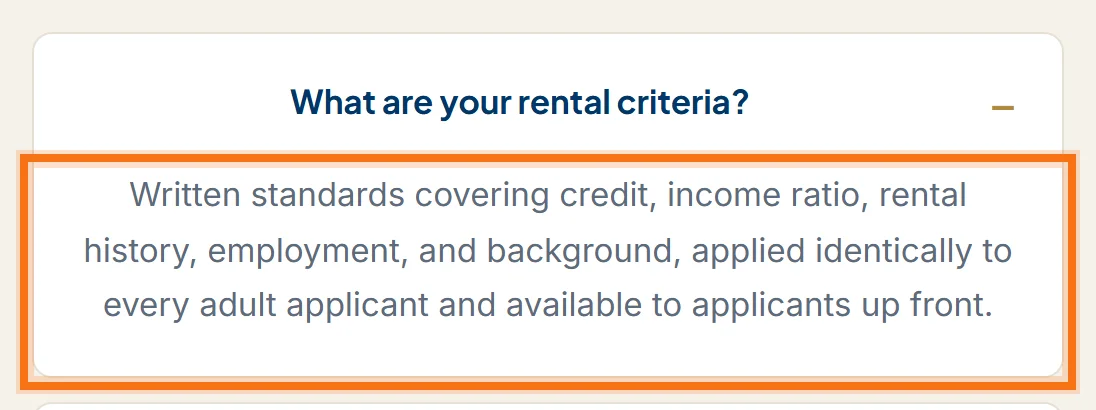
It also protects the relationship. Verifying the income of a coworker feels awkward for a few minutes; chasing that coworker for rent is awkward for a year. The applicant pays the application fee and applies like a stranger would. If the result is a no, the manager can deliver it against the written criteria, so you are not the one saying it to someone you know.
Four ways owners find tenants, and the question each raises
Owner-sourced tenants arrive in a few recognizable ways, and each raises its own question for the agreement:
A friend, relative or coworker. Full application, standard lease, and a fee agreed in advance. If they are family, read hiring a property manager when you rent to a friend or family member.
A tenant already living in the house. That is a takeover, not a placement: the existing lease, deposit records and keys move to the manager. How that works is in how a property manager takes over mid-lease.
Someone who saw the manager's listing but called you. The manager's marketing produced the lead. Check whether your agreement counts anyone who inquires while the house is listed as the manager's applicant.
Someone you lined up before signing with the manager. Name the person, or the date, in the agreement so nobody argues later about who found whom.
How to agree the fee before your tenant applies
Fee disputes over owner-sourced tenants usually come from timing: the owner mentions the tenant after marketing has started, or nobody read the placement clause. Before your tenant applies:
- Find the clause that covers a tenant you procure, and confirm the fee in the written quote.
- If you already have someone in mind, say so before signing and have the agreement name them or the date.
- Confirm your tenant applies under the manager's standard application and criteria and pays the usual application fee.
- Confirm the fee includes the lease, the deposit handling and the move-in inspection, with no separate charges.
- Ask what happens if your tenant does not qualify: does the house go to market at the standard fee, and from what date?
The last answer matters most. A declined applicant should lead straight into normal marketing, not into a week of nobody owning the next step. Our leasing service page describes the lease and move-in work that sits inside a placement.
When finding your own tenant is a false economy
Supplying a tenant saves the marketing once. It can cost more than that if the person you found pays below market, is a weaker applicant than a listing would produce, or is someone you will find hard to hold to the lease.
Illustrative only, not a quote. Say your tenant moves in three weeks sooner than a listed house would lease, at rent of $2,000: about $1,400 of rent you would otherwise not have received ($2,000 times 21 divided by 30, checked as $66.67 a day times 21). Now say you agreed $1,900 instead of a $2,000 market rent: that is $100 a month, $1,200 over a 12-month lease, which is $450 more than the $750 owner-sourced fee in the example above (checked: $750 plus $450 is $1,200). Lost rent is income not received, not cash out of pocket, but it counts the same at year end.
If your candidate is strong and the rent is at market, take the saving. If you are choosing them mainly to save a fee, check the rent first with a free rental analysis.
Our placement fee and what the site says about your own tenant
What our site states, and nothing beyond it:
- Placement fee. Our price sheet lists tenant placement at 50% of one month's rent on the Full Service and Investor Special plans and 75% on the Standard plan. Investor Special is for portfolios of 5 or more units.
- Your own tenant. Our leasing page answers "Can you lease it if I already found the tenant?" with yes: we can paper and manage a tenancy you sourced, though we recommend full screening first, and we will explain the trade-offs honestly.
- The application. Our rental criteria require a separate application from each applicant 18 or older at $60 per applicant, income of at least 3 times the rent counting the 2 highest earners, pay stubs covering at least 6 weeks and 2 months of bank statements, and a photo ID. Denied or canceled applications are non-refundable.
- Who decides. Our screening page says decisions stay criteria-based: you set the standards with us, and we apply them without exceptions.
- Move-in. A photo-documented move-in condition report, and deposits handled per the Texas Property Code.
Our site does not publish a separate fee for a tenant you found, so the fee for that placement is confirmed in writing before you sign; every number on our price sheet is, and if a fee is not in the agreement, you do not pay it. To talk through your tenant, call 682-593-7033.

The takeaway: Finding the tenant saves the marketing half of a lease-up. Pay for the half that protects you, the application, lease, deposit, move-in record and keys, and agree the figure in writing before your tenant applies.
Questions owners ask
Do I pay a leasing fee if I find the tenant myself?
It depends on your management agreement. Some charge the full placement fee however the tenant was found, some set a reduced fee for a tenant you procure, and some price the lease and move-in steps separately. You saved the marketing and showings; the application, lease, deposit, move-in record and keys still have to be done. Get the figure in writing before your tenant applies.
Can I ask the manager to skip screening for a tenant I already know?
You can ask, but a careful manager will apply the same written criteria to your tenant as to anyone else, and you should want that. The decision rests on documents rather than on who knows whom, and it protects a personal relationship from a rent problem later. The applicant pays the usual application fee. If they qualify, nothing is lost.
What if the tenant I found does not qualify?
The manager tells the applicant, with the reason tied to the written criteria, and the house goes to normal marketing at the fee your agreement sets for that. Ask in advance from what date marketing starts so there is no gap. Learning that an applicant falls short before move-in is cheaper than learning it after.
Does a tenant who saw the manager's listing but called me count as my tenant?
Check your agreement. Some count anyone who inquires while the house is listed as the manager's applicant, because the marketing produced the lead, and charge the standard fee. If you had someone lined up before the listing went live, name them or the date in the agreement when you sign.
Is there a fee if a manager takes over a tenant already living in my house?
That is a takeover, not a placement, so a placement fee may not apply; other onboarding charges may. Ask what the agreement charges for taking over an occupied house. With us, the price sheet lists an enrollment inspection on each plan, and our screening page says we take over occupied properties as-is and apply full screening at the next vacancy.
What does Perpetual charge to place a tenant I found myself?
Our price sheet lists tenant placement at 50% of one month's rent on Full Service and Investor Special and 75% on Standard. It does not publish a separate fee for a tenant you found, so that figure is confirmed in writing before you sign. Our leasing page confirms we can paper and manage a tenancy you sourced, and we recommend full screening first.
Does my tenant still pay an application fee if I found them?
With a manager, usually yes, because the application and verification still happen. On our rental criteria, each applicant 18 or older submits a separate application at $60, and denied or canceled applications are non-refundable. Tell your tenant before they apply, so the fee and the documents they need are no surprise.
Related services
Property management in Keller, North Richland Hills and Fort Worth. How full-service management works in Tarrant County →