
Key takeaways
- The stage decides the money: approved only, holding money paid, or lease signed.
- Texas defines an application fee as nonrefundable and an application deposit as refundable if the applicant is rejected (Property Code 92.351). An approved applicant who withdraws is neither case, so the written terms decide.
- A signed lease binds the tenant even if they never move in. If a replacement moves in by the start date, Property Code 92.1031 limits what you keep.
- Relist the same day. The days the house sits empty are the real cost.
- Our rental criteria are published: $60 per adult applicant, and denied or canceled applications are non-refundable.
What happens if an approved tenant backs out before moving in? The house goes back on the market, the next qualified applicant gets a call, and the money follows how far the paperwork got. On a rental in Fort Worth, Keller or North Richland Hills, that gives three different answers: an approval alone costs you only time, money paid under written holding terms is kept or refunded as those terms say, and a signed lease still binds the tenant.
This guide is the owner's side of the next two weeks: what to do on day one, the Texas rules at each stage, what the gap costs and how to make a repeat less likely. The deposit and leasing-fee mechanics are covered in more depth in when an approved tenant backs out before move-in.
What happens at each stage when an approved tenant backs out
Here is what changes depending on how far the applicant got, the Texas rule behind each stage and your first move:
| Stage | What happens to the money | The Texas rule | Your first move |
|---|---|---|---|
| Approved, nothing else signed or paid | The application fee paid for screening and is not refunded | Property Code 92.351: an application fee is a nonrefundable sum that offsets the cost of screening | Relist and contact the next qualified applicant |
| Approved, holding money paid, lease not signed | Kept or refunded as the written holding terms say | Section 92.351 makes an application deposit refundable if the applicant is rejected; it says nothing about an approved applicant who withdraws | Read the holding terms and get the withdrawal in writing |
| Lease signed, tenant never moves in | The tenant is bound by the lease; the security deposit can be applied to what is owed, with an itemized list | The lease, plus Property Code 92.104 on deductions | Relist the same day and keep a record of every re-letting step |
| Lease signed, replacement moves in by the start date | You keep only a lease cancellation fee agreed in the lease, or your actual re-letting expenses | Property Code 92.1031 | Account for the deposit in writing |
How to read this table: the further down you go, the stronger your position on the money and the more it depends on what was signed. In every row the first move is the same: put the house back in front of renters.
The first day: get it in writing, relist, call the next applicant
Three things happen before anything else. First, the withdrawal goes in writing: an email or text from the applicant, with the date. A phone call saying "we might not" is not a withdrawal, and a verbal one invites a dispute about money later. Second, the listing goes live again with the same photos and price. Third, the next qualified applicant from the same round is contacted before new showings are booked.
That applicant is the fastest route to a lease because they have already seen the house. Their application still has to meet the same written criteria as everyone else, and anything out of date is re-verified. Check the timing too: an applicant who was never sent an acceptance is treated as rejected after seven days, so a backup from two weeks ago is not automatically still pending. How a manager decides between several applications is in choosing between several qualified applicants.
What Texas law says about application fees and deposits
Subchapter I of Property Code chapter 92 governs rental applications. Four parts of it matter when an approved applicant changes their mind:
- Two kinds of application money. Section 92.351 defines an application fee as a nonrefundable sum given to offset the cost of screening, and an application deposit as money given with an application that is refundable to the applicant if the applicant is rejected.
- Seven days to accept. Under section 92.352, an applicant is deemed rejected if the landlord does not give notice of acceptance on or before the seventh day after a completed application is submitted.
- Published criteria. Section 92.3515 requires the landlord to make the tenant selection criteria available with the application. A landlord who rejects an applicant without having done so must return the application fee and any application deposit.
- No waiver. Section 92.355 makes void any provision of a rental application that tries to waive these rights.
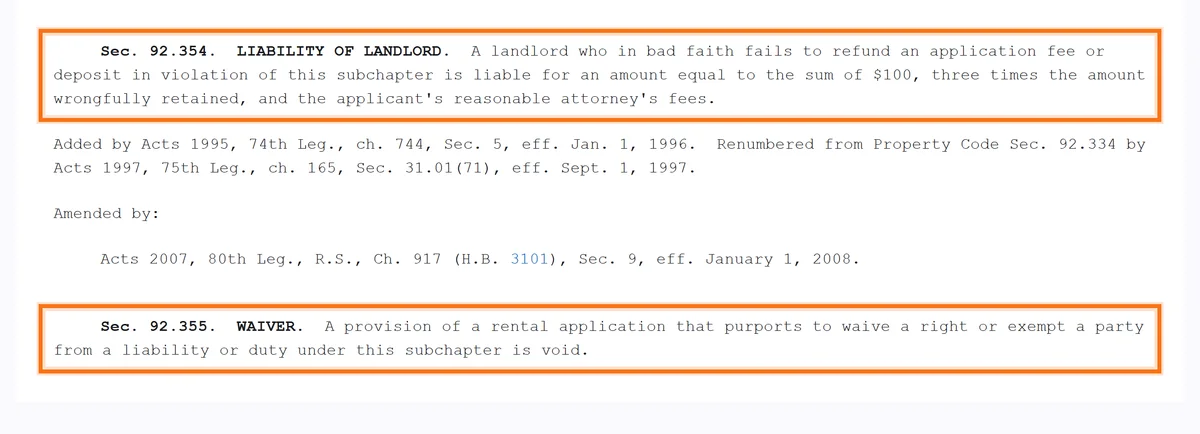
What the statute does not do is tell you what happens to money from an approved applicant who simply walks away. That is a contract question: the holding or application terms the applicant signed decide it. Terms that say plainly what the money is, when it converts to a security deposit and when it is kept are worth more than any argument afterward. This is general information, not legal advice.
If the lease was already signed
Once the lease is signed, the applicant is a tenant under a contract, whether or not they ever collect the keys. Backing out is a breach of the lease, not a withdrawal, and the lease decides what they owe: usually rent until the house is re-let, plus any reletting charge or lease cancellation fee the lease sets.
Texas adds two limits. Under Property Code 92.1031, if a replacement tenant satisfactory to the landlord moves in on or before the start date of the lease, the landlord may not keep the security deposit or rent prepayment, except either a lease cancellation fee agreed in the lease or the actual expenses of securing the replacement, including a reasonable amount for the landlord's time. And Property Code 91.006 gives a landlord a duty to mitigate damages when a tenant abandons the premises in violation of the lease; a lease cannot waive it.
In practice that means the same habit as before signing: relist at once and document every step. Deductions from the deposit go to the tenant with a written description and itemized list (Property Code 92.104). The full deposit rules are in Texas security deposit rules. This is general information, not legal advice.
The leasing fee and your management agreement
Owners worry most about paying a leasing fee for a tenant who never arrived. The answer is in your management agreement, not in any statute: it says when the placement fee is earned (at lease signing, at move-in or at first rent) and what happens if the tenant never takes possession.
Three questions to ask any manager before you sign:
- When exactly is the placement fee earned, and is it charged again if the first tenant never moves in?
- If an approved applicant forfeits money under holding terms, who keeps it: you, the manager or a split?
- Does a placement guarantee cover a tenant who signs and then never moves in?
The answers should be in writing, because the time you need them is the week a withdrawal happens. The wider list of fee questions is in hidden property management fees, and our own fees are on the price sheet.
What the withdrawal actually costs, with an example
Illustrative only, not a quote. Rent is $2,000 a month. An approved applicant withdraws ten days before the planned move-in, with no lease signed. The next applicant from the same round signs and moves in 14 days after the original date. A day of rent is $2,000 x 12 / 365, about $65.75, so the gap is 14 x $65.75, about $920 of rent you did not receive.
That $920 is income not received, not cash you paid out. The cash costs are smaller and separate: utilities for the extra days and, if the house was touched again, another cleaning. If the applicant had paid money under holding terms that say it is kept on withdrawal, that money offsets part of the gap.
Run the same facts with a signed lease and a replacement who moves in after the start date: those 14 days are rent the departing tenant owes under the lease, and the deposit can be applied to it with an itemized list. The owner who took the house off the market on a verbal approval, with nobody else in line, starts from zero. What a vacant month really costs walks through the full arithmetic.
Making a repeat less likely
Withdrawals cluster around a few causes, and each has a countermeasure:
- A long gap between approval and signing. Plans change while people wait. Have the lease ready to sign within days of approval.
- Vague money terms. If an applicant pays anything beyond the application fee, the written terms should state the amount, the signing deadline and when it is kept.
- An incomplete application. An applicant approved on a file with gaps is a weaker commitment. Our criteria say an application is not considered valid until all paperwork and fees are in.
- Silence after approval. A tenant who hears nothing starts to doubt. Move-in instructions, utility setup and key handover details keep the move real.
None of this guarantees an applicant will not change their mind. It shortens the window in which they can, and it makes the money clear if they do.
How Perpetual handles this
Perpetual Property Management is broker-owned, with our office at 5755 Rufe Snow Dr in North Richland Hills, and we lease homes in Keller, North Richland Hills, Fort Worth and nearby. What our site states about applications and placement:
- Published criteria, applied to every applicant. Our rental criteria list the income rule (3 times the rent, counting the 2 highest earners), the screening and the causes for rejection.
- A $60 fee per adult applicant. Each applicant 18 or older applies separately, and the criteria state that denied or canceled applications are non-refundable.
- The placement fee is 50% of one month's rent on Full Service and Investor Special and 75% on Standard, charged when a tenant is placed (leasing and move-in).
- A placement guarantee. If a tenant we place defaults and is removed, or breaks the lease, within the first 6 months, we find you a new tenant with no additional leasing fee, subject to the Guarantee Addendum.
- A listing guarantee. Your home is live on every major rental platform within 5 business days of being market-ready, or we waive the first month's management fee.
Whether we take holding money from approved applicants, and exactly how the placement fee and the guarantee apply to an applicant who withdraws or signs and never moves in, are confirmed in writing before you sign. To set this up before you list, request a free rental analysis or call 682-593-7033.
The takeaway: Get the withdrawal in writing, relist the same day and let the signed paperwork, read against the Texas rules, decide the money.
Questions owners ask
Can an approved tenant get their holding deposit back if they change their mind?
It depends on the written terms they signed. Property Code 92.351 makes an application deposit refundable if the applicant is rejected, but it does not address an approved applicant who withdraws, so the holding or application terms decide. If those terms say the money is kept when an approved applicant does not sign, it is usually kept. If there were no written terms, expect a dispute. This is general information, not legal advice.
If the tenant signed the lease, can I keep the whole security deposit?
Not automatically. You can apply the deposit to what the tenant owes under the lease, usually rent until the house is re-let plus any reletting charge the lease sets, and send a written description and itemized list of deductions. If a replacement moves in on or before the lease start date, Property Code 92.1031 limits what you keep to a lease cancellation fee agreed in the lease or your actual re-letting expenses.
How fast can the house be re-let after a tenant backs out?
It depends mainly on whether another qualified applicant is waiting. If the next applicant from the same round still wants the house, a lease can follow within days once their application is verified. If the listing has to restart, it is the normal marketing period for your price and area. The days between the original move-in date and the new one are the real cost.
Do I pay a second leasing fee for the replacement tenant?
That depends on your management agreement: when the placement fee is earned and whether it is charged again if the first tenant never moves in. Ask before you sign, and get the answer in writing. With Perpetual, the placement fee is charged when a tenant is placed; ask us how that applies to a withdrawal before you sign.
Is the application fee refundable if an approved applicant backs out?
Generally no. Property Code 92.351 defines an application fee as a nonrefundable sum paid to offset the cost of screening, and the screening has been done. The exceptions in the statute concern rejected applicants, such as a landlord who rejects an applicant without having made the selection criteria available. Our criteria state that denied or canceled applications are non-refundable.
Can a landlord keep the deposit if a tenant signs a lease and never moves in?
Partly, depending on the lease and on timing. If nobody moves in by the start date, the lease decides what the tenant owes, and the deposit can be applied to it with an itemized list. If the landlord finds a replacement who moves in on or before the start date, Property Code 92.1031 allows keeping only a lease cancellation fee agreed in the lease or the actual expenses of securing the replacement. This is general information, not legal advice.
Related services
Property management in Keller, North Richland Hills and Fort Worth. How full-service management works in Tarrant County →