Key takeaways
- When the tenant pays utilities, judge an upgrade by the owner's costs: repairs, equipment life, empty days and renewals.
- Payback = net cost of the upgrade / the owner's yearly benefit, using your own quote and repair history.
- The IRS home energy credits are for your own main home, and the IRS pages say they ended for work after December 31, 2025.
- An improvement to a rental is capitalized, not deducted all at once (IRS Publication 527).
- Attic insulation, duct sealing and the air conditioner at replacement come first; windows and solar rarely pay in a rental.
Are energy efficiency upgrades worth it in a rental property? Some are, but not for the reason a homeowner's calculator gives. When the tenant pays the electric bill, the savings go to the tenant. For a rental in Fort Worth, Keller or North Richland Hills, an upgrade pays the owner back only through repairs avoided, equipment that lasts longer, fewer empty days and tenants who renew.
Below: which upgrades an owner controls, the payback arithmetic on your own quote, what the IRS says about energy credits for landlords in 2026, and the upgrades in order.
Rental energy upgrades: who gets the benefit
Here are the usual upgrades, who sees the lower bill when the tenant pays utilities, what the owner gets, and when to do the work:
| Upgrade | Lower bill goes to | What the owner gets | When to do it |
|---|---|---|---|
| Attic insulation and air sealing | Tenant | Less running time on the owner's air conditioner, fewer hot-room complaints | At turnover, house empty |
| Sealing and insulating attic ducts | Tenant | Cooler far rooms, fewer complaint calls | At turnover or with an HVAC visit |
| Air conditioner sized from a load calculation | Tenant | A system that is not oversized for the house | Only when the old one is replaced |
| Solar screens or window film, west and south | Tenant | Fewer hot-room complaints at low cost | At turnover |
| LED bulbs, ceiling fans, a simple smart thermostat | Tenant | Better listing photos, a thermostat you can watch while the house is empty | At turnover |
| Water heater replaced on age | Tenant (gas or electric) | Fewer failures and leaks, which are the owner's problem | Before it fails |
| Window replacement | Tenant | Rarely anything, unless windows are broken or fogged | Only as a repair or renovation |
| Solar panels | Tenant | Rarely anything; the roof under them is still the owner's | Rarely in a single-family rental |
How to read this table: in a tenant-paid house the second column is always the tenant, so read the third column. An upgrade earns its place when that column names a cost you actually pay. Where the owner pays utilities, such as a shared meter, the second column becomes you and the math changes.
The split incentive: why homeowner math does not apply
When a homeowner adds attic insulation, their own bill drops and the upgrade pays back over time. When a rental owner does the same in a house where the tenant pays utilities, the tenant's bill drops. The owner paid for the insulation and sees nothing on a utility line. This is the split incentive, and it is why so many upgrades that make sense for a homeowner do not, on paper, for a landlord.
The upgrades that still pay have a second effect the owner does pay for. Insulation and sealed ducts make the air conditioner run less, and the air conditioner is the owner's. A house that stays comfortable in August generates fewer complaint calls and is easier to rent in August. Judge each upgrade by the owner's costs and the owner's vacancy, not by the tenant's bill.
Where the owner pays utilities, in a duplex with a shared meter or a furnished rental with bills included, the homeowner math returns and most upgrades pay faster.
Payback on your own quote: the arithmetic
Simple payback is the net cost of the upgrade divided by the owner's yearly benefit. Use your contractor's written quote for the first number. For the second, use only benefits you pay for and can estimate from your own records: repair calls avoided, empty days saved, a renewal kept.
Illustrative only, not a quote. Say attic insulation and air sealing on your house is quoted at $2,400. From your own repair history you expect it to save one $300 air conditioner service call a year. You also expect it to shorten one summer vacancy by five days every three years. At $2,000 rent, a day is $2,000 x 12 / 365 = $65.75, so five days is $328.77, or $109.59 a year.
- Owner's yearly benefit: $300 + $109.59 = $409.59.
- Payback: $2,400 / $409.59 = 5.86 years.
- Without the repair saving: $2,400 / $109.59 = 21.90 years, which is not an investment.
- With a $400 rebate in writing: $2,000 / $409.59 = 4.88 years.
The answer turns on the repair assumption, so base it on your own invoices. The rental ROI guide shows how to fold an improvement into the full return.
Energy tax credits and rebates for a rental in 2026
Many payback calculators still subtract a federal tax credit. For a rental, check that first. The IRS page for the Energy Efficient Home Improvement Credit says the credit is for improvements to your main home, and adds: "You can't claim the credit if you're a landlord or other property owner who doesn't live in the home." It also says you can claim it for improvements made through December 31, 2025.
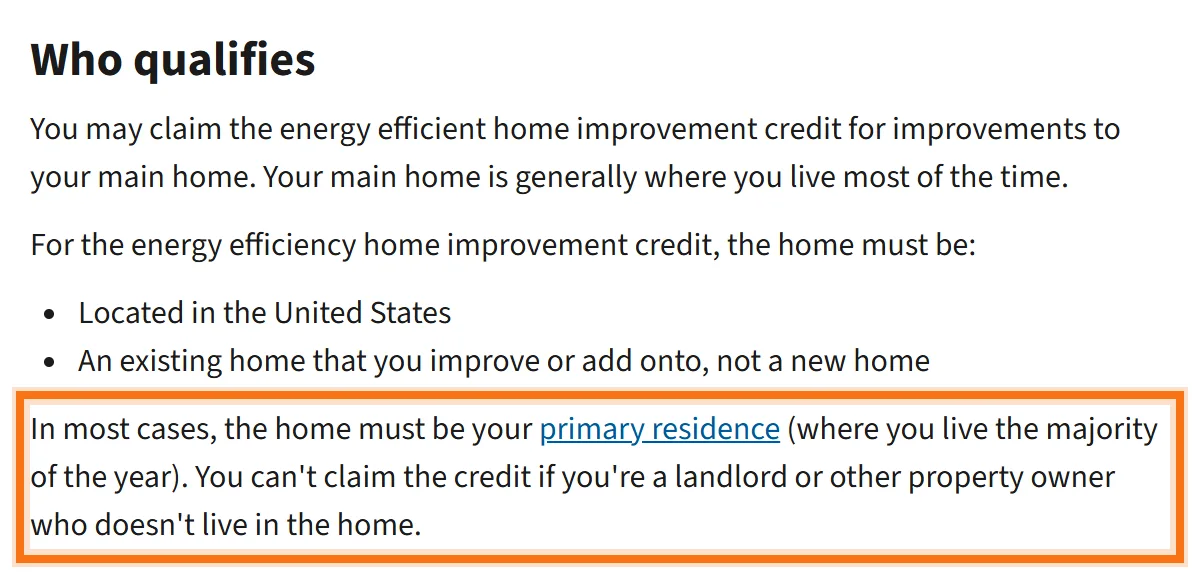
The IRS page for the Residential Clean Energy Credit (solar and similar property) says the credit is not available for property placed in service after December 31, 2025, and carries the same sentence about landlords. So for a rental you do not live in, plan on no federal home energy credit in 2026.
Two more points from IRS Publication 527. You must capitalize an expense that improves your rental property, such as one that results in a betterment, so an upgrade is generally recovered through depreciation rather than deducted in one year. And a utility or manufacturer rebate lowers your net cost, which is the number to use in the payback. Ask your electricity provider whether any program covers rental property, and count it only once it is in writing. This is general information, not tax advice; confirm with your CPA.
Attic insulation and air sealing: usually first
In a North Texas house the ductwork usually runs through the attic, and a thin or settled insulation layer lets attic heat into the living space and the ducts. Topping up the insulation and sealing the gaps where the attic meets the house, around lights, plumbing penetrations, the attic hatch and the top plates, is often the most useful upgrade on an older home.
The owner's return is the air conditioner: a system in a cooler house runs fewer hours, and fewer hours means less wear. The HVAC guide explains why that system is the largest repair line on many DFW rentals.
Radiant barrier is the usual add-on question; treat it as a second step after insulation depth and air sealing. Have the contractor confirm attic ventilation before adding anything, and get the scope in writing so you can compare quotes like for like.
The air conditioner: replace on age, size it properly
Do not replace a working air conditioner to gain efficiency: the savings go to the tenant and you have spent a large sum early. Replace at end of life, and make the efficiency choice then. Ask the contractor to size the new system from a load calculation for the house rather than copying the old nameplate, since an oversized system short-cycles and dehumidifies poorly.
During the system's life, the cheap items do the most: sealed and insulated ducts, a clear condenser, a clean coil through regular service, and a filter schedule set by the equipment maker's instructions. Those protect the equipment you own and cut the hot-room calls.
Windows: rarely worth it in a rental
Window replacement is the upgrade owners ask about most and the one that returns least in a rental. The cost is high, the energy effect goes to the tenant, and renters rarely pay more for new windows unless the old ones are visibly failing. A window that is broken, fogged between the panes or no longer locks is a repair, not an efficiency project.
On the west and south sides, solar screens or a quality window film cut the afternoon heat on the rooms that generate hot-room complaints, at a fraction of replacement cost. Redo the weatherstripping and caulking at the same time. Full replacement belongs in a renovation that repositions the whole house.
Thermostats, lighting, fans and water
A simple smart thermostat and LED bulbs cost little and show up well in a listing. Neither saves the owner much on a bill, but a connected thermostat earns its keep while the house is empty: it can hold a safe temperature and show you if the system stops. The rental technology guide covers choosing one that does not become a support call.
Replace bulbs with one color temperature through the house and note it on the finish spec so replacements match. Ceiling fans in bedrooms and the living room are inexpensive and let the tenant run the air conditioner less in spring and fall.
Water is closer to the owner's wallet, because leaks become owner problems. Aerators and efficient toilets are routine turnover items. Replace the water heater on age, before it fails, with a standard unit of the right size, and insulate exposed hot water lines in the attic and garage. Fix running toilets and dripping hose bibs promptly.
Appliances, solar and the upgrades to skip
Replace appliances when they fail, with efficient mid-range models, and let efficiency be a tiebreaker rather than the reason to replace early.
Solar panels rarely work on a single-family rental. The cost is large, the savings go to the tenant's bill, panels on a lease or loan complicate a sale, and the roof under them still has to be replaced on its own schedule. The IRS Residential Clean Energy Credit page says that credit is not available for property placed in service after December 31, 2025, and that a landlord who does not live in the home cannot claim it.
Also usually on the skip list for a typical rental: tankless water heaters, whole-house dehumidifiers, geothermal, and any upgrade whose payback depends on a rebate you have not confirmed in writing.
Describing the upgrades in the listing
Applicants understand specifics, not claims. In the listing, say what was done: added attic insulation, sealed ductwork, a new air conditioner, LED lighting, a smart thermostat, solar screens on the west side, ceiling fans in every bedroom. That tells an applicant the house will be comfortable without promising a number.
Do not quote an average utility bill unless you have a past tenant's actual bills with permission and present them as one household's history. A listing that promises low bills and delivers ordinary ones starts the tenancy with a broken promise. Our marketing process puts those specifics in the listing description.
How Perpetual handles efficiency work on a managed home
Perpetual Property Management is broker-owned, with our office in North Richland Hills, and we manage rentals in Keller, North Richland Hills, Fort Worth and nearby. What our site states that bears on efficiency work:
- Inspections: every plan includes an annual property inspection, and the property enrollment inspection is $125 on Investor Special, $49 on Standard and included on Full Service.
- Vendors and approvals: we use plumbers, electricians, HVAC vendors and general trades repeatedly. You set a pre-approved spending limit; larger jobs come to you with a description, photos and a recommendation.
- Invoices: maintenance coordination is a percentage of the vendor's invoice (4.9% on Standard, 5% on Full Service; make-ready coordination 3% to 5% of cost on Investor Special), and the original invoice is always in your portal. Every completed repair over $500 gets photo or video proof.
- Older homes: our maintenance page notes that much of Northeast Tarrant's housing stock is 30 to 50 years old, and that planned attention to aging HVAC, water heaters and roofs beats emergency pricing.
Whether we gather efficiency quotes for you as part of a turnover is confirmed in writing before you sign. Our maintenance coordination page covers how repairs are approved. To see what the rent supports before you spend, request a free rental analysis or call 682-593-7033.
The takeaway: Run the payback on your own quote using only benefits you pay for, assume no federal home energy credit for a rental, spend on attic insulation, ducts and the air conditioner at replacement, and skip the upgrades that only lower the tenant's bill.
Questions owners ask
Are energy efficiency upgrades worth it for a rental property?
Some are. When the tenant pays utilities, the owner's return comes from fewer repair calls, longer equipment life, fewer empty days and tenants who renew, not from the bill. Attic insulation, air and duct sealing, and a right-sized air conditioner at replacement usually pass that test. Run the payback on your own quote, using only benefits you actually pay for.
What is the best energy upgrade for a rental in Texas?
On most older homes, attic insulation and air sealing, with the attic ducts sealed while the crew is up there. In North Texas the ducts usually run through the attic, and a cooler house means fewer running hours on the owner's air conditioner. Get the scope in writing and compare quotes like for like.
Should I replace the windows in my rental to save energy?
Rarely. The cost is high, the savings go to the tenant, and tenants do not pay more rent for new windows unless the old ones are visibly failing. Solar screens or window film on the west and south sides handle the heat load for a fraction of the cost. Replace a window when it is broken or fogged.
Does solar make sense on a rental house?
Usually not. The install cost is large, the savings go to the tenant's bill, panel loans or leases complicate a sale, and the roof underneath will need replacement on its own schedule. Owners who want solar for their own reasons can do it, but the rent will not carry it.
Can I advertise my rental as energy efficient?
Describe the specific upgrades, such as added insulation, sealed ducts, LED lighting and a smart thermostat, and let the applicant draw the conclusion. Do not quote an average utility bill unless you have actual bills with permission and present them as one household's history. Promising low bills you cannot guarantee starts the tenancy badly.
Can a landlord claim the energy efficient home improvement tax credit?
Not for a rental you do not live in. The IRS page for the credit says it is for your main home and that you can't claim it if you're a landlord or other property owner who doesn't live in the home. The page also says the credit covers improvements made through December 31, 2025. This is general information, not tax advice; confirm with your CPA.
How do I work out the payback on an energy upgrade for my rental?
Divide the net cost (the written quote minus any rebate confirmed in writing) by the owner's yearly benefit: repair calls avoided, empty days saved at your daily rent, renewals kept. In the illustrative example, $2,400 / $409.59 a year = 5.86 years. Leave out the tenant's utility savings unless you pay the bills.
Related services
Property management in Keller, North Richland Hills and Fort Worth. How full-service management works in Tarrant County →