Key takeaways
- TREC rule 535.2: agreements for brokerage services must be accepted in a broker's name, so your agreement does not leave with the agent.
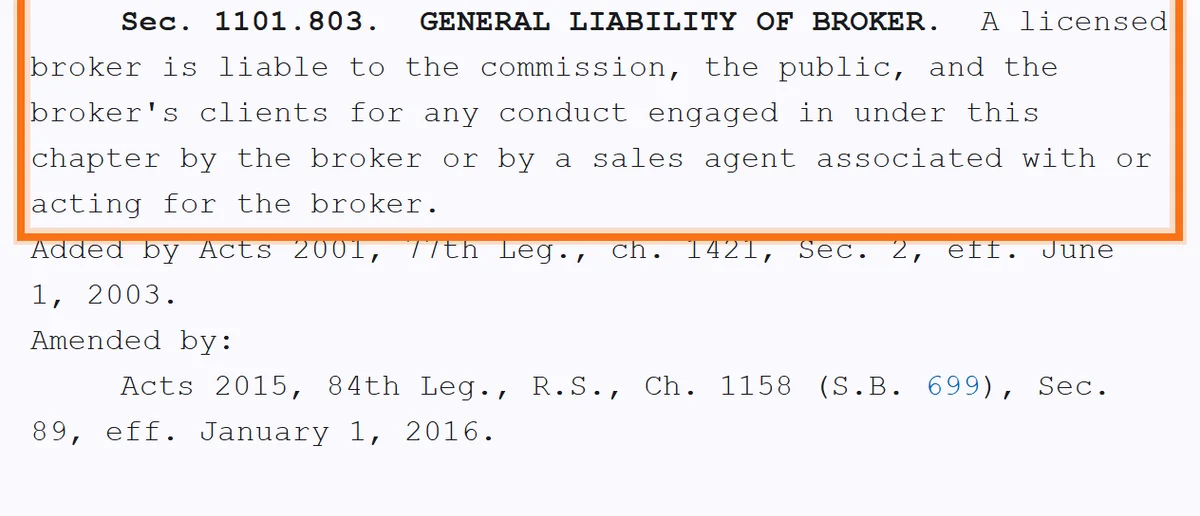
- Occupations Code 1101.803: a licensed broker is liable to the public and its clients for the conduct of a sales agent acting for it.
- When the broker is a company, its designated broker carries the broker responsibilities (rule 535.2; Occupations Code 1101.355).
- Legal responsibility is not coverage: a second person, a tenant portal, an emergency line and records anyone can open are what keep a rental running.
- Put the backup, the reassignment notice and your access to records in writing before you sign.
Who covers your property if your manager quits or is unavailable? The brokerage you signed with. In Texas a management agreement is accepted in a broker's name, not the individual's, so if your contact leaves, the broker still answers for your rental. For an owner in Fort Worth, Keller or North Richland Hills, the more practical question is who picks up the phone in the meantime, and that depends on the company's bench, not on the law.
This guide covers what Texas law and TREC rules say about broker responsibility, the difference between a company with a bench and one person with a phone, what should happen when a manager leaves, and the clauses to insist on.
Who covers what when your manager is gone
Here is who is responsible in each situation, what should happen, and what to check before it ever comes up:
| Situation | Who answers for your rental | What should happen | What to check now |
|---|---|---|---|
| Your contact is on vacation or sick | The brokerage, under your agreement | A named backup handles your file; the tenant uses the portal and the emergency line | Who the backup is, and whether they can open your file today |
| Your contact leaves the company | The brokerage; the agreement stays with it | You are told who takes over; nothing changes for the tenant | How and when the agreement says you will be told |
| You want to follow the departing agent | The brokerage, until you end the agreement under its terms | You give notice, then sign with the new company; records and money move | Notice period and any termination charge |
| The agent managed on the side and goes silent | The sponsoring broker (rule 535.2; Occupations Code 1101.803) | You write to the designated broker and ask who now handles your account | The broker's license on the TREC license holder search |
| The whole company closes | Nobody is left to perform the agreement | You recover the deposit, rent and records | See the closing guide linked below |
How to read this table: in the first four rows a licensed broker still answers for your rental, and the only question is how well the company is set up to show it. The last row is different in kind, and what happens to your rental if the management company goes out of business covers it.
What Texas law and TREC rules say about who is responsible
Texas real estate licensing puts the responsibility on the broker, not on the individual who answers your emails. Here is what the rules say, as read:
- TREC rule 535.2: listings and other agreements for real estate brokerage services must be solicited and accepted in a broker's name. A broker is responsible for any property management activity by its sponsored sales agent that requires a license, and may delegate supervision but may not relinquish overall responsibility. When the broker is a business entity, the designated broker carries those responsibilities. The broker keeps property management contracts for at least four years.
- Occupations Code 1101.351(c): a sales agent may not engage in real estate brokerage unless sponsored by a licensed broker and acting for that broker.
- Occupations Code 1101.355(a)-(b): a company must designate one of its managing officers as its broker, and may not act as a broker unless that person is a licensed broker in active status and good standing.
Two consequences follow. A departing agent cannot take your agreement along, and you are not released from it either: to follow that agent, you end the agreement under its own terms first. And if an agent who managed on the side goes silent, the sponsoring broker is the one to write to. This is general information, not legal advice.
A company with a bench versus one person with a phone
The difference between arrangements shows up exactly here. A company with more than one person on the file, shared systems and a broker who reviews the accounts can absorb an absence with the owner barely noticing. A sales agent managing a few houses on the side, under a legitimate sponsoring broker, is a different proposition: the broker is legally responsible, but may know nothing about your house, your tenant or your lease until the day the agent stops answering.
Neither is wrong for every owner, and a solo manager can be attentive and good. The test is the weeks they are not available. Ask: if you were unreachable for three weeks, who would my tenant call about a leak, who would handle the rent, and who would answer me? The full comparison is in management company vs an agent who manages on the side.
What good backup looks like in practice
Coverage during an absence is built from systems, not promises. Look for:
- An emergency line the tenant can call at any hour, answered by someone who can send a vendor.
- A tenant portal where rent is paid and repair requests are logged, so neither depends on one inbox.
- An owner portal where statements, documents and payout history are posted.
- A file a second person can read: the lease, inspection reports, your spending limit and your contact preferences.
- A named backup who already knows the account, and a broker who can step in.
Illustrative example. Your contact is out for two weeks and the air conditioning fails in a North Richland Hills rental in August. With the systems above, the tenant reports it through the portal or the emergency line, a vendor goes out within your spending limit, and the request and invoice show up where you can see them. Without them, the tenant calls a cell phone that goes to voicemail. How night calls should be handled is in how property managers handle after-hours emergencies.
When your manager quits: what should happen
When an individual leaves a brokerage, the company should tell you promptly, name the person taking over, and confirm that nothing changes for the tenant: same portal, same payment instructions, same emergency number. Your agreement, fees and spending limit continue as written, because the agreement was with the brokerage all along.
If the handover is not communicated, or the new contact does not respond, write to the designated broker, ask who now handles your account, and keep a copy. If the silence continues, treat it as the company failing to perform under the agreement: what to do when your property manager won't respond walks through the steps. If the whole company is closing, the problem is different, because there is nobody left to perform; the closing guide linked in the table above covers getting the deposit, the rent and the records back.
What to insist on in the management agreement
Five lines in the agreement turn "the broker is responsible" into coverage you can use:
- The broker by name. The brokerage and its license number, so you know who answers if your contact disappears. Check it on the TREC license search: how to verify a property manager's Texas license.
- Notice of reassignment. A promise to tell you in writing who takes over your account if your contact changes, and that your terms stay the same.
- Your access to records. Statements, documents and payout history in a portal you can open without asking anyone. A license holder who fails to surrender to the owner, without just cause, a document the owner requests can be disciplined (Occupations Code 1101.652(a)(5)).
- The tenant's channel. A tenant portal and an emergency number that do not depend on one person's phone.
- Your way out. The notice and any charge to end the agreement if service fails; read it with what to look for in a property management agreement.
This is general information, not legal advice.
Five questions to ask before you sign
Five questions settle this in the first meeting:
- Who is the designated broker, and how involved are they in day-to-day management?
- If my contact leaves, who takes over, and how will I be told?
- What does my tenant do about a leak at nine on a Saturday night if my contact is away?
- Where are my lease, inspection reports and statements kept, and can someone else open them today?
- Has the company lost a manager before, and what did it do for the owners affected?
Good answers name people and systems. Weak answers are reassurances about dedication. You are not doubting anyone's commitment; you are asking what the structure does when one person is not available. The contact page is the place to ask them.
How Perpetual handles this
Here is what our site states about who stands behind your agreement and how the systems run:
- The broker: Perpetual Property Management is a registered assumed name of Perpetual Realty Group, LLC, TREC Broker Company License 9008702-BB. Justin Brown is the Broker/Owner, TREC Broker License 549418-B, licensed since 2006 (our disclosures page).
- An office and a team: our office is at 5755 Rufe Snow Dr, Suite 155, in North Richland Hills, and our contact page says you will reach a local team. Under our communication guarantee we respond to your calls and emails within one business day.
- Systems that do not depend on one phone: tenants pay rent, review the lease and submit maintenance requests in the tenant portal; every plan on our price sheet includes 24/7 emergency response; your statements, documents and disbursement history are in the owner portal on AppFolio.
Who covers your account when your contact is away, and how you are told of a change, are confirmed in writing before you sign. To ask those questions about your house, request a free rental analysis or call 682-593-7033.
The takeaway: Your agreement belongs to the broker, and the broker answers for the agents acting for it. Whether that protects you on an ordinary Tuesday depends on the bench behind your contact, so ask who covers, how the tenant reaches help, and where your records live, and get the answers in writing.
Questions owners ask
If my property manager leaves the company, can I follow them to their new brokerage?
Only by ending your agreement with the current brokerage under its own terms and signing a new one with the new brokerage. Agreements for brokerage services are accepted in the broker's name (TREC rule 535.2), so the agent cannot take yours along. Check the notice period and any termination charge first, and make sure the deposit, rent and records move cleanly between the two companies.
What happens to my tenant if the property manager is unreachable?
The tenant should still be able to pay rent and report repairs through a portal and an emergency number that do not depend on one person. If no one answers, the tenant's repair rights under Texas law run against you as the landlord, so you may need to step in directly, then raise the company's failure in writing with its designated broker.
Is a one-person property management company a bad idea?
Not necessarily, but it needs a real answer to the coverage question. A solo manager with an answering service, a portal, standing vendor arrangements and a sponsoring broker who knows the accounts can cover absences. One who is the tenant's only phone number, with records on a personal laptop, cannot. Ask what happens during a three-week absence and judge the specifics.
Does the sponsoring broker have to step in if my agent disappears?
The obligation sits with the broker. TREC rule 535.2 makes a broker responsible for its sales agents' licensed property management activity, and Occupations Code 1101.803 makes a broker liable for the conduct of a sales agent acting for it. Whether the broker can step in quickly depends on access to your records. Write to the designated broker and ask who now handles your account.
How do I find out who the broker behind my property manager is?
Look at your management agreement and the Information About Brokerage Services form the company gave you, then check the name on the TREC license search, where you can search by name or license number and filter by license status. A company acts as a broker only through a designated broker who is a licensed individual broker in active status (Occupations Code 1101.355(b)).
Does my management agreement end if my property manager quits?
No. The agreement is with the brokerage, so it continues after an individual leaves, on the same terms, until it ends under its own provisions. What should change is only the name of the person handling your account, and the company should tell you who that is. If the brokerage itself closes, see our guide on a management company going out of business.
Related services
Property management in Keller, North Richland Hills and Fort Worth. How full-service management works in Tarrant County →