Key takeaways
- You generally buy the house subject to the existing lease: the rent, the end date and every addendum come with it.
- Ask for documents, not descriptions: lease, addenda, estoppel, 12 months of ledger, deposit records, condition report.
- Property Code 92.105: the new owner is liable for the deposit from the date title is acquired, so get it credited at closing.
- After closing, give the tenant a signed statement naming you and the exact deposit amount, as 92.105(b) requires.
- Underwrite on the lease rent until it ends, then price both a renewal and a turnover.
What should you check before buying a rental with a tenant in place? The lease and every addendum, a signed estoppel from the tenant, a rent ledger you can verify, the deposit amount and records, and the condition report from move-in, all before your option period ends. For a house in Fort Worth, Keller or North Richland Hills, Texas Property Code 92.105 makes the new owner liable for the deposit from the date title is acquired, so the deposit belongs on your closing statement.
Below is a document table with the red flag in each, then how to read the lease, verify the tenancy, handle the deposit and run the first 30 days. This is general information, not legal advice.
What to ask the seller for: the document table
Here are the documents to request in your first written request, why each matters, and the red flag to look for:
| Ask for | Why it matters | Red flag |
|---|---|---|
| The lease and every addendum, signed | You generally take the house subject to it: rent, end date, pets, repair duties, renewal terms | A missing page or addendum, a handwritten change, an option to purchase or right of first refusal |
| A written statement of side agreements | Promises outside the lease surface later as disputes | The seller will not answer in writing |
| A tenant estoppel certificate | The tenant confirms the rent, deposit, paid-through date and any claims | The tenant refuses, or the numbers differ from the seller's |
| 12 months of rent ledger, with proof | Shows the real payment pattern, not the sales version | Payments after the grace period with fees waived, partial payments, no ledger at all |
| Security deposit amount and records | You are liable for it from the date title is acquired (92.105) | The seller wants to "send it later," or the records do not match the lease |
| Move-in condition report and photos | You need a baseline to itemize deductions at move-out | None exists |
| Maintenance history and open repair requests | Open requests become your obligation after closing | A repair the tenant has been asking about for months |
| The seller's management agreement, if any | Shows who holds the deposit and records today | A manager who has not been told about the sale |
How to read this table: one red flag is a question for the seller, not a reason to walk away. Two or three, or a seller who will not put answers in writing, belong in the price or in your decision to use the option period. The property side of the purchase, from condition to HOA rules, is in how to evaluate a rental before you buy.
You are buying a house and a lease you did not write
As a rule, the buyer of a rented house takes it subject to the existing lease: the rent, the end date, the pet terms, the repair duties and any renewal or purchase rights the seller agreed to. You cannot raise the rent or change the rules until the lease allows it. How your purchase contract and the lease work together is a question for your attorney before the option period ends.
That makes the lease the first document to read, before the inspection report and before the comparable sales. A good house on a weak lease is a weak purchase for as long as the lease runs. Ask for it in your first written request, and treat a seller who is slow to produce it as a yellow flag.
Read the lease the way a manager would
Go through the lease and every addendum with these questions, and write the answers down:
- Term and end date. Fixed term or month-to-month? What notice does non-renewal take, and from whom?
- Rent. Amount, due date, grace period, late fee and payment method. Compare it to a current rental analysis; below-market rent is a real cost until the lease ends.
- Deposit. The amount, and any part labeled as a pet deposit.
- Occupants and pets. Who is named and which animals are allowed.
- Responsibilities. Lawn, pest control, filters, utilities. What the owner carries is your expense from closing day.
- Renewal and purchase rights. Automatic renewals, early termination terms, an option to purchase or a right of first refusal, which can change the whole transaction.
If the lease is a handwritten page or an out-of-state form, plan to move the tenant onto a full Texas lease at renewal; what a Texas residential lease must cover lists the clauses.
Get a tenant estoppel certificate
An estoppel certificate is a short statement the tenant signs confirming the facts of the tenancy: the lease dates, the current rent, the deposit paid, the date rent is paid through, that no rent is prepaid beyond that, that the tenant has no claims against the owner and that no agreements exist outside the lease.
It matters because the seller's version and the tenant's version do not always match. The seller may say the deposit was one month's rent while the tenant holds a receipt for more, or may have promised a new fence in the spring. Make the estoppel a contract condition with a deadline inside the option period, and ask your lender whether it wants one. A tenant who refuses to sign is information too: ask why before you go on.
Verify the rent ledger, not the description of it
"Always pays on time" is a sales sentence, not a record. Ask for at least twelve months of the rent ledger, with every charge, payment, late fee and balance, and for something that proves it: bank deposits or the seller's manager's statements. Look for:
- Payments after the grace period, even when the fee was waived.
- Partial payments or balances carried forward.
- Rent that changed mid-lease without a written amendment.
- Gaps that line up with repair disputes.
A tenant who pays on the tenth every month with the fee waived has been trained to pay on the tenth, and you inherit the pattern. Resetting it means enforcing the lease as written from your first month. If the seller cannot produce a ledger at all, treat the tenancy as unverified and price it that way.
The deposit: what Property Code 92.105 says
The deposit is where buyers most often get hurt, because the statute puts the duty on you from day one. Texas Property Code 92.105, as read today:
- (a) When the owner's interest ends by sale or otherwise, the new owner is liable for the return of security deposits from the date title to the premises is acquired.
- (b) The new owner shall deliver to the tenant a signed statement acknowledging that the new owner has acquired the property and is responsible for the tenant's security deposit, and specifying the exact dollar amount of the deposit.
- (b-1) The former owner stays liable for a deposit received while it owned the house until the new owner has received the deposit or assumed the liability, unless the parties specify otherwise in a written contract.
So get the full deposit credited to you on the closing statement, never "sent later," and confirm the amount against the lease and the estoppel. Section 92.106 requires a landlord to keep accurate records of all security deposits, so ask the seller for them. Texas security deposit rules covers move-out. This is general information, not legal advice.
Inspection access when someone lives there
You still get a full inspection, but the lease shapes how it happens. No Texas statute sets a notice period for entry; the lease's access clause does. Have the seller or the seller's agent give the notice the lease requires and agree a time with the tenant, and plan one well-organized visit rather than several short ones.
Look hard at what tenants live with and stop reporting: a slow drain, a window that does not lock, HVAC that runs constantly, painted-over water stains. Ask for the seller's maintenance history and any inspection reports; a house with a record has fewer unknowns, and unknowns belong in the price.
Meet the tenant before closing
A ten-minute conversation tells you what a ledger cannot. Is the tenant planning to stay? Is there a repair they have given up asking about? Do they know the house is being sold? Ask with the seller's permission and keep it short and courteous; you are meeting them, not interviewing them.
If you will use a property manager, bring the manager in now, so the tenant hears once, before closing, where rent goes and how repairs are requested. How a property manager takes over mid-lease covers the manager's side of that hand-over.
Underwrite the rent you will actually collect
Underwrite on three numbers, not the listing's rent: the lease rent until it ends, the market rent you could reach at renewal, and the cost of a turnover if the tenant leaves instead.
Illustrative only, not market data. The lease has eight months left at $1,850 and a rental analysis puts market rent at $2,000, a $150 gap that costs $1,200 over those months.
Over your first year, a renewal at $2,000 gives 8 x $1,850 + 4 x $2,000 = $14,800 + $8,000 = $22,800 of rent. If the tenant leaves and the house sits empty one month, it is $14,800 + $6,000 = $20,800 (re-added: $8,000 + $14,800 = $22,800 and $6,000 + $14,800 = $20,800, one month's rent apart), and the make-ready and leasing costs come on top as cash. Weight the two by what the tenant told you about staying. Raising rent at renewal is covered in how much to raise the rent and how to notify.
The first 30 days after closing
From the tenant's side, closing day starts a new tenancy, so run it like a move-in:
- Deliver the signed statement 92.105(b) requires: you own the house, you are responsible for the deposit, and its exact dollar amount.
- Tell the tenant in writing where and how to pay and how to request repairs, so the first payment after closing lands in the right account.
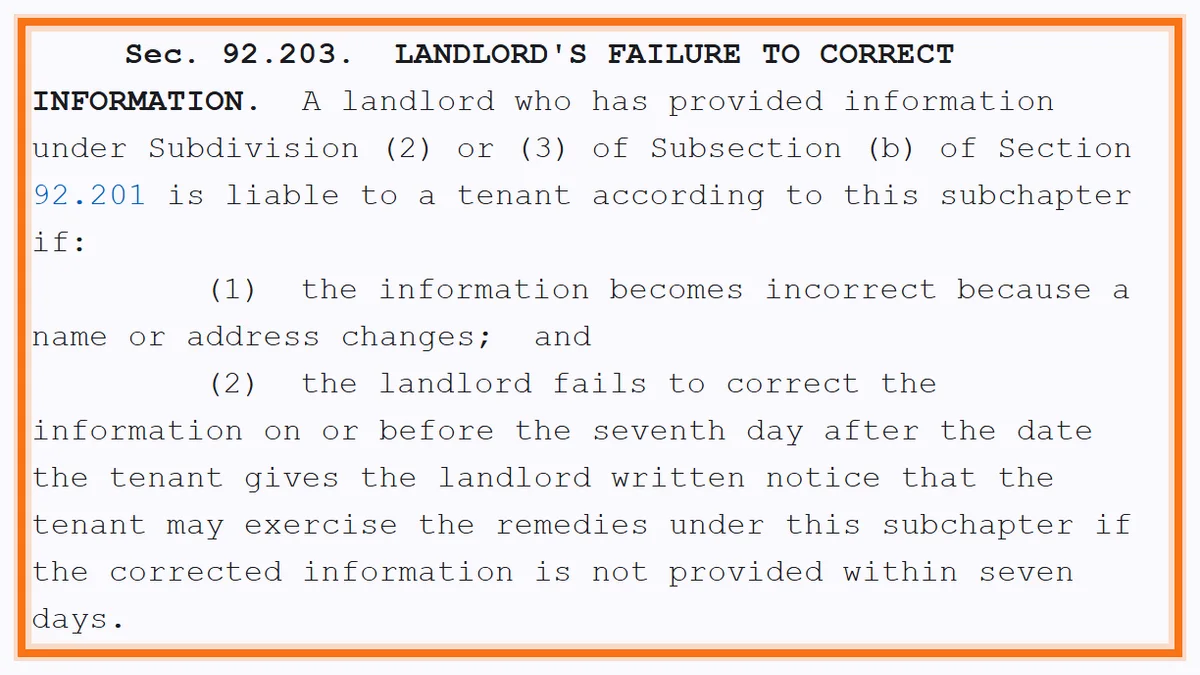
- Update the owner name and address the tenant has. Property Code 92.201 requires a landlord to disclose the record owner's name and address, and an off-site management company's name and street address, when the tenant asks or in the lease or a posting; if that information is in the lease and becomes incorrect, 92.203 applies.
- Walk the house with the tenant and record its condition from your ownership forward.
- Fix the repair the tenant has been waiting on.
- Calendar the lease end and the renewal decision date.
- Ask your insurance agent, before closing, what policy the house needs as a rental from your first day.
The seller's side of the same sale is in selling a rental with a tenant in place, and what a manager does during a sale is in how a property manager helps sell a rental with tenants still living there. Have an attorney review the lease and contract before your option period ends. The rest of the setup between contract and closing (management agreement, insurance, utilities, HOA rules) is in managing a newly purchased rental before closing.
How Perpetual helps when you buy a tenant-occupied rental
Perpetual Property Management is broker-owned, based in North Richland Hills, and our affiliated brokerage, Perpetual Realty Group, works with buyers. Our site states:
- On the purchase: acquisition analysis, negotiation and due diligence "from a broker who thinks like an investor," and managed owners get one team across buying, leasing, managing and eventually selling.
- On the rent: a free rental analysis with a rent range from leased comparables, which our analysis page says is often most useful when a property is occupied.
- After closing: we regularly take over occupied properties; the lease, deposit and records transfer to us, and tenants get new payment and maintenance instructions.
- The condition record: an enrollment inspection when management begins (included with onboarding on Full Service, $49 on Standard, $125 on Investor Special), separate from our 360-degree inspection at every move-in and move-out.
Which documents we collect from a seller, and when management begins relative to your closing, are confirmed in writing before you sign. To start, request a free rental analysis on the house you are considering, read about buying through Perpetual Realty Group, or call 682-593-7033.
The takeaway: Verify the tenancy with documents, get the deposit credited at closing, and give the tenant one clear notice in the first week, so the only change the tenant sees is where the rent goes.
Questions owners ask
Do I have to honor the existing lease when I buy a rental in Texas?
As a rule, yes: the buyer takes the house subject to the existing lease, including the rent, the end date and the addenda, and cannot raise the rent or change the rules until the lease allows it. Read the full lease and every amendment before the option period ends, and have your attorney confirm how your contract treats it. This is general information, not legal advice.
What is a tenant estoppel certificate and do I need one?
It is a short statement the tenant signs confirming the lease dates, rent, deposit, paid-through date, any claims against the owner and that no side agreements exist. It brings out differences between the seller's story and the tenant's before you own them. Make it a contract condition with a deadline inside the option period, and ask your lender whether it wants one.
What happens to the security deposit when I buy a tenant-occupied property?
Under Property Code 92.105, the new owner is liable for returning it from the date title is acquired, and must give the tenant a signed statement naming the exact deposit amount. The seller stays liable until you have received the deposit or assumed the liability, unless a written contract says otherwise. Get the full deposit credited to you at closing. This is general information, not legal advice.
Can I raise the rent right after buying a rental with a tenant?
Not during a fixed-term lease unless the lease allows it. You can raise it at renewal, or on a month-to-month tenancy with the written notice the lease requires. Underwrite on the lease rent until the lease ends, and price both a renewal and a turnover.
Should I keep the seller's property manager after closing?
Only if you would hire them on your own. Interview the seller's manager like any other, review their records, and if you choose someone else, plan the hand-over so the tenant has one clear contact from closing day. Ask who holds the deposit today, because it has to reach you at closing.
Do I have to tell the tenant I am the new owner?
Yes, in writing. Property Code 92.105(b) requires the new owner to deliver a signed statement acknowledging the purchase and responsibility for the deposit, with its exact dollar amount. Section 92.201 also requires a landlord to disclose, on request or in the lease, the record owner's name and address and an off-site management company's name and street address. Send one clear notice with payment and repair instructions in your first week. This is not legal advice.
What if the seller never collected a deposit or spent it?
Find out before closing. The ledger, the lease and the tenant's estoppel should all show the same deposit. Because you are liable for the deposit from the date you take title, any deposit the tenant paid should be credited to you on the closing statement, and a mismatch should be settled in writing before you sign. This is general information; your attorney and title company confirm the details.
Property management in Keller, North Richland Hills and Fort Worth. How full-service management works in Tarrant County →