
Key takeaways
- Decide who signs first: the employee as tenant (the company may guarantee in writing), or the company as tenant with the employee as a named occupant.
- Texas has no statutory lease exit for a civilian job transfer; an early-termination right exists only if your lease writes one.
- A guarantee from an employer must be in writing and signed (Business and Commerce Code 26.01), and covers only the original term unless the lease says otherwise (Property Code 92.021).
- Most relocating households move their own furniture; furnishing is a different business with its own guide.
- The house must be finished before move-in day: the truck arrives on a fixed date.
How do you rent a DFW house to a corporate relocation tenant? Decide who signs, write the transfer terms into the lease yourself, and have the house finished before the move date. For an owner in Fort Worth, Keller or North Richland Hills, the relocating tenant usually has a fixed start date and little time to look, so the owner who has those answers ready before the house-hunting trip is the one who signs the lease.
Below: the two lease models side by side, what Texas law supplies and what it leaves to the lease, the transfer clause, furnished or not, and move-in readiness.
Employee lease or company lease: the two models side by side
Here is how the two ways of papering a relocation tenancy compare, point by point:
| Point | Employee signs (individual lease) | Company signs (corporate lease) |
|---|---|---|
| Who is the tenant | The employee and any co-applicants | The company; the employee and family are named occupants |
| Who owes the rent | The tenant; the employer only if it signs a written guarantee | The company |
| Employer guarantee | Must be in writing and signed (B&C Code 26.01(b)(2)); covers the original term only unless the lease meets 92.021(b) | Not needed: the company is already the tenant |
| Screening | Each adult applies against the written criteria | Who is screened and how must be agreed in writing |
| Employee leaves the job | The employee still owes the lease | The company still owes the lease; replacing the occupant is a lease question |
| Lease form | Your standard Texas lease and addenda | Often the company asks for its own form or addendum: have it reviewed against Texas law |
| Lease over one year | Must be in writing to be enforceable (B&C Code 26.01(b)(5)) | Same |
How to read this table: the employee lease keeps your normal process and puts the risk on a person you screened; the company lease puts the risk on the company but changes who is screened, who lives there and what happens when people move. Neither is better in general; what matters is deciding before the application arrives. This is general information, not legal advice; a Texas attorney can review a company's lease form.
Who the relocation tenant is
"Corporate relocation tenant" covers several people: an employee transferred within a company, a new hire arriving from another state or country, an executive on a set assignment of a year or more, and a family renting for a year while they learn the area before buying. What they share is a fixed start date and little time to decide. What differs is who pays, who signs and how long they expect to stay.
Ask those three questions at the first inquiry. The answers decide which lease model below fits, whether a transfer clause is on the table, and whether the house needs to be furnished.
When a relocation company is involved
Some employers hand the move to a relocation company or give the employee a relocation agent. When that happens, the inquiry may come through the agent, the showing may be one of several on a short trip, and you may be asked for a company addendum, a direct-billing arrangement or a deposit paid by company check.
None of that changes your rules. Rent, deposit and screening follow your written criteria and your lease; an addendum is a contract change to read before signing, not a formality; and money from a third party should be in the lease or a signed guarantee so it is clear who owes what. If the relocation side asks for terms your lease does not have, the answer can be yes, but in writing and before move-in.
Who signs: the person or the company
This is the decision most owners make by default instead of on purpose. With an individual lease, the employee is the tenant, screened like anyone else, and the employer may promise to pay if the employee does not. In Texas, that promise must be in writing and signed by the employer to be enforceable (Business and Commerce Code 26.01(b)(2)), and a guarantor is liable only for the original lease term unless the lease meets the renewal rules in Property Code 92.021(b).
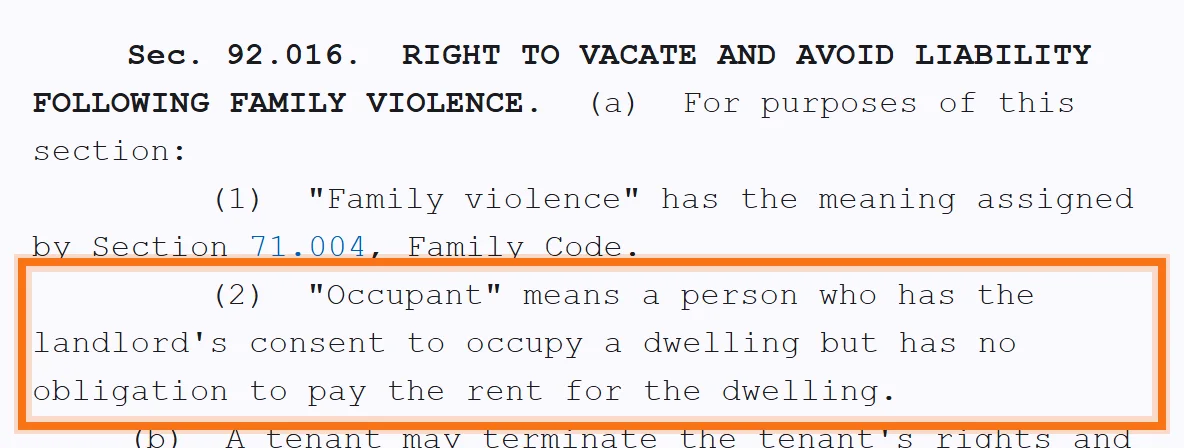
With a corporate lease, the company is the tenant and the employee's household are occupants: people with your consent to live there who do not owe the rent. The Property Code uses exactly that idea when it defines an occupant in section 92.016.
With a company as tenant, check that the person signing has authority to bind it, name every occupant in the lease, and decide whether the company may swap in a different employee. A company's own lease form may be written for another state: have it reviewed against your Texas lease before you sign it.
Lease length and the transfer clause Texas law does not supply
Most relocating households ask for twelve months. Some want six or nine because they plan to buy; some assignments run two or three years. A lease longer than one year must be in writing to be enforceable (Business and Commerce Code 26.01(b)(5)). A shorter term means an earlier turnover, so price it accordingly or plan the renewal.
The transfer clause is where these tenants differ. The Property Code lets a tenant end a lease early only in set situations: family violence (92.016), certain sex offenses or stalking (92.0161), the death of a sole occupant (92.0162) and military service or orders (92.017). A civilian job transfer is not one of them, so any transfer right exists only if your lease grants it.
If you grant one, write it narrowly: an employer-directed transfer only, a written notice period with rent paid through it, a copy of the transfer letter, and a defined fee that covers your reletting cost. Without a clause, a tenant who leaves early is in breach, and you then have a duty to mitigate your damages that the lease cannot waive (Property Code 91.006). When a tenant wants to break the lease covers that path.
Furnished or unfurnished
Most relocating households move their own furniture, and the employer often pays to ship it, so an unfurnished house on a twelve-month lease is the usual fit. A furnished home suits a narrower group: an executive on an assignment without household goods, or an arrival waiting on a shipment. Renting furnished means buying, insuring and replacing the furniture and writing an inventory into the lease, which is a different business; should you furnish your rental walks through it.
A middle path works for some owners: unfurnished, with a refrigerator, washer and dryer included. Write the appliances that stay into the lease, and see which appliances to provide for who repairs them.
Condition on day one
A relocating family arrives on a date set by a moving company. The truck comes whether or not the dishwasher works, and the family has no time to chase a repair in a city they do not know yet.
The standard is the condition the photos show: professionally cleaned, every system tested, every appliance running, blinds hung, bulbs working, lawn maintained, keys, remotes and codes ready. Finish the make-ready a week before the move-in date, not the night before, so there is time to fix what the final walk-through finds. Then document the condition with a dated, photo-documented move-in report the tenant acknowledges. How quickly a manager gets a house ready covers the make-ready itself.
The house-hunting trip decides it
Many transferees see the area once before they move, on a trip of a few days. If your house cannot be shown during that trip, it is not in the running. A relocation-ready process looks like this:
- Showings available on short notice, including self-guided tours for a verified prospect.
- A full set of listing photos and a floor plan for the family member who could not travel.
- Published rental criteria, so the applicant knows what is verified before paying a fee.
- An online application that can be completed from a hotel room.
- Electronic lease signing and a way to pay the deposit from out of state.
Screening still takes the time it takes: employers and previous landlords have to answer. Tell the applicant the realistic timeline up front so they can plan their temporary housing.
Screening an applicant who is moving in from elsewhere
An applicant moving in from elsewhere brings paperwork that may not match a local applicant's: income that starts next month, rental history in another city, or a mortgage instead of a landlord. The answer is not to bend the rules for them; it is to know before the trip what your written criteria ask for, so they can bring it.
Our published criteria, for example, ask every applicant 18 or older to apply separately, with ID, income of at least 3 times the rent shown by pay stubs (minimum 6 weeks) and 2 months of bank statements, and 3 years of residential history; the screening covers credit, rental history, employment and income verification, and a criminal background check. Send the criteria with the first reply, and the applicant arrives with the right documents. Tenant screening criteria in Texas explains how written criteria are set.
Pricing for a relocation tenant
Price a relocation tenant the way you price anyone: from homes like yours that actually leased, not from asking rents. A relocation agent may show several comparable homes on one afternoon, and an overpriced house drops off that tour. Let condition and readiness win the tie.
Where a relocation tenant can be worth more is in the terms: a clear term, rent paid on schedule, a company that guarantees or signs, and a renewal if the assignment is extended. A free rental analysis gives the rent range from leased comparables; what a rental analysis should include explains how to read it.
How Perpetual handles a relocating applicant
Here is what our site states that matters to a tenant arriving from out of town:
- Showings: self-guided and scheduled showings through ShowMojo, so a qualified prospect can tour the same day they find the listing; most showings are self-guided.
- Applying: online, the same day. Each applicant 18 or older applies separately, at $60 per applicant, with ID, income of at least 3 times the rent (pay stubs, minimum 6 weeks, and 2 months of bank statements; only the two highest earners count) and 3 years of residential history. Our rental criteria apply the same way to every applicant.
- Decision: screening typically takes 1 to 3 business days once a complete application is in.
- Move-in: a Texas lease with property-specific addenda, a photo-documented move-in report acknowledged by the tenant, and a 360-degree move-in condition inspection under the Perpetual Promise. See our leasing page.

Whether an offer letter can stand in for pay stubs, how a company applicant is screened, and whether we accept a company's own lease form or a transfer clause are confirmed in writing before you sign. To price and prepare your house for this tenant, request a free rental analysis or call 682-593-7033.
The takeaway: With a relocation tenant, settle who signs, write the transfer terms into the lease (Texas law will not supply them), get any employer guarantee in writing, and finish the house before the moving truck's date.
Questions owners ask
Should the company or the employee sign the lease for a corporate relocation?
Either can work, but decide before the application. An individual lease keeps your normal screening, and the employer can guarantee the rent in a signed writing. A corporate lease makes the company the tenant and the employee's household occupants, which puts the rent on the company but requires proof of signing authority, named occupants and clear rules on swapping them.
How long a lease do corporate relocation tenants want?
Twelve months is the most common request. Some ask for six to nine months because they plan to buy, and some assignments run two or three years; a lease longer than one year must be in writing (Business and Commerce Code 26.01). Expect a request for an early termination right if the employer moves the employee again.
Do I need to furnish my rental to attract corporate tenants?
Usually not. Most relocating households move their own furniture and want an unfurnished home on a twelve-month lease. Furnishing suits short executive assignments or arrivals waiting on a shipment, and it means buying, insuring and inventorying the furniture: a different business with its own guide.
How do I verify income for a tenant who has not started the job yet?
Start from your written criteria and send them with the first reply, so the applicant knows what to bring. Our published criteria ask for pay stubs covering at least 6 weeks and 2 months of bank statements, income of at least 3 times the rent, and 3 years of residential history, applied the same way to every applicant. Whether other documents can stand in is something to settle in writing before the application.
What should a transfer clause in the lease say?
Texas law does not give a civilian job transfer a right to end a lease, so the clause is the only source of that right. Write it narrowly: an employer-directed transfer only, written notice with rent paid through the notice period, a copy of the transfer letter, and a defined fee covering your reletting cost. Have a Texas attorney review it.
Do property managers market rentals to people relocating for work?
A good one makes the house easy to choose on a short trip: full listing photos, self-guided or scheduled showings on short notice, published criteria and an online application. Our marketing includes ShowMojo self-guided and scheduled showings and listing on the major rental sites, and applicants can apply online the same day they tour.
Can a tenant who relocates for work end the lease early in Texas?
Not by law, unless the lease allows it. The Property Code's early exits cover family violence (92.016), certain sex offenses or stalking (92.0161), a sole tenant's death (92.0162) and military service or orders (92.017). A civilian transfer is not on that list, so "flexible check-out" for a job move exists only if the lease includes a transfer clause. Otherwise an early move-out is a breach, and the landlord must mitigate under 91.006.
Can the employer guarantee the rent instead of signing the lease?
Yes. In Texas, a promise to answer for another person's debt must be in writing and signed by the person making it, or someone authorized to sign for them (Business and Commerce Code 26.01). Under Property Code 92.021, a guarantor is liable only for the original lease term unless the original lease states the renewal terms the section lists. This is general information, not legal advice.
Related services
Property management in Keller, North Richland Hills and Fort Worth. How full-service management works in Tarrant County →