Key takeaways
- Ask for per-property numbers on the houses you own first: rent collected, fees and repairs for each address, so you know what kind of house has worked.
- For the house you are considering, ask for a rent range from leased comparables and a read on condition: what needs attention, what may delay leasing, what needs a vendor's estimate.
- Check the service area before you buy in another city or county.
- Our Investor Special is for portfolios of 5 or more units at 7% of monthly rent; the quote should be revisited as your holdings change.
- A manager supplies operating evidence; financing, entity and tax decisions belong with your lender, attorney and CPA.
Yes, a property manager can help you plan for more rentals as your portfolio grows, within a clear limit. For owners in Fort Worth, Keller and North Richland Hills, the useful help is evidence before the next closing: what each house you already own actually nets, what the next one will rent for, what it needs before a tenant, and how the management plan changes as you add doors. A manager should not tell you whether to buy or how much to borrow.
This guide lists the five requests to make, works an illustrative per-property comparison, and explains where the manager's role ends.
Five requests to make before your next purchase in DFW
Here is what to ask a property manager for before you buy the next rental, what each request tells you, and what our own site says we provide:
| Request | What it tells you | What Perpetual's site states |
|---|---|---|
| Per-property numbers for each house you own | Which kind of house has netted well, and which has not | Per-door reporting, monthly statements, and an AppFolio owner portal with statements, documents and disbursement history |
| A rent range for the house you are considering | Whether the rent supports the price | A free rental analysis with a rent range from leased comparables |
| A condition read before you commit | What needs attention, what may delay leasing, what needs a vendor's estimate | A property manager can review a prospective house before purchase |
| A service-area check | Whether the new address can be managed the same way as the rest | Portfolios across Tarrant, Dallas, Collin and Denton counties; a mixed-city portfolio is reviewed as a package |
| A plan review for your new size | How fees change as you add homes | Investor Special for portfolios of 5 or more units; pricing revisited as holdings change |
How to read this table: the first request looks backward and the other four look forward. Ask for all five in writing, so the decision rests on documents rather than on a conversation you will half remember at closing.
Start with per-property numbers for the rentals you own
If a manager has run your rentals for a year, the most useful numbers in your plan already exist: rent collected, the management fee, placement or renewal fees, repair invoices and any coordination charge, for each address. That is an operating record, not a projection.
Ask for it per property, not blended. Then add your own mortgage, tax and insurance for each house. The result shows which kind of house has been worth owning, which is the best guide to choosing the next one. How a manager can keep each house separate is in tracking income and expenses for each rental, and how to read the statement itself is in how to read your owner statement.
What to ask for on the next house
For the house you are considering, ask for evidence, not an opinion:
- A rent range from homes that actually leased, not asking rents, with the comparables themselves so you can see how the house compares.
- A condition read: what needs attention, what may delay leasing, and what work needs a vendor's scope or estimate. Leave any unpriced cost open in your numbers until it is priced.
- The HOA's leasing rules, if there is an association: read the restrictions and rules yourself; how to check whether an HOA allows renting covers the steps.
- A service-area answer if the house is in a different city or county from the rest.
What changes as the portfolio grows
Each added house adds its own lease end date, its own reserve needs and its own repairs. Three things are worth planning before they collide:
- Lease end dates. Two turnovers in the same month mean two make-readies and two vacancies at once. Look at when each lease ends and when renewal work starts; how far ahead renewals start explains the timing.
- Reserves per house. Size them by each house's systems, not as one pot; see how much reserve to keep per rental.
- Pricing and structure. Portfolio pricing may apply as the count grows, so ask for the quote again; portfolio pricing for multiple rentals explains how owners with several homes are quoted. Whether to hold in an LLC is a question for an attorney and CPA; the LLC overview covers the basics.
What changes operationally as you scale is in from one rental to a portfolio.
Bringing the homes you already own under one manager
Growth often starts with consolidation: two houses with one manager, one you self-manage, a third with a different company in another city. Before you add a house, decide whether the ones you own should sit under the same agreement, the same portal and the same reporting, so the per-property numbers above can be compared at all.
Moving an occupied home does not require selling it or waiting for the lease to end. What transfers is the lease, the security deposit and the property records, and the tenant gets new instructions for rent and maintenance. What decides the timing is your current management agreement's notice and termination terms, so read those first. The full sequence is in how to switch property managers.
On our side, for several homes we organize the handover around each home's status: occupied, approaching renewal, vacant, or with maintenance in progress. After you give notice, we coordinate with your current manager, and we will say so if your existing agreement makes it worth waiting.
An illustrative per-property comparison
Illustrative only, not a quote. Assume an owner has two rentals, both rented all twelve months last year. House A renewed its tenant; House B placed a new one and needed more repairs. To give the formulas real numbers, the example uses the Standard plan on our price sheet: 9% of monthly rent, placement at 75% of one month's rent, renewal $200, maintenance coordination 4.9% of cost. Here is the year, per house:
| Line | House A ($1,800 rent) | House B ($1,750 rent) |
|---|---|---|
| Rent collected | $21,600 | $21,000 |
| Management fee (9%) | -$1,944.00 | -$1,890.00 |
| Renewal or placement fee | -$200.00 (renewal) | -$1,312.50 (placement) |
| Repair invoices + 4.9% coordination | -$900 - $44.10 = -$944.10 | -$2,400 - $117.60 = -$2,517.60 |
| Net before mortgage, tax, insurance and HOA | $18,511.90 | $15,279.90 |
How to read this table: the rents differ by $600 a year, but the nets differ by $3,232, mostly from the placement fee and the larger repair bill. That is the kind of difference to understand before you choose the next house: ask why House B turned over and what its repairs were, then look for the same signs in the house you are considering. The arithmetic: $21,600 - $1,944 - $200 - $944.10 = $18,511.90; $21,000 - $1,890 - $1,312.50 - $2,517.60 = $15,279.90.
Where a manager's role ends
A manager should not tell you how much to borrow, whether to refinance, how to hold the property for tax purposes, or whether a purchase is a good investment for you. Those depend on your finances, goals and tax position, and they belong with a lender, a CPA and, for entity questions, an attorney. This is general information, not financial, legal or tax advice.
A manager also benefits when you buy another house, which is one more reason to ask for documents rather than reassurance: leased comparables, a written condition list, a written quote. Evidence you can check protects you from anyone's enthusiasm, including your own.
Choosing a manager that can grow with you
Owners searching for a "rental portfolio manager" that can scale with them usually need the same few things. Ask any manager you are considering:
- Do I get per-property statements, so each house can be read on its own?
- Can you review an address before I make an offer, and what will I receive in writing?
- Which counties and cities do you serve, and how is a house outside them handled?
- How does your pricing change as I add homes, and when is the quote revisited?
- Are screening criteria and leases the same at every address?
How many homes one manager can handle well is a separate question, covered in how many rentals is too many for one property manager.
How Perpetual helps a portfolio grow
Perpetual Property Management is broker-owned. Justin Brown, a Texas Broker, owns both Perpetual Property Management and our affiliated brokerage, Perpetual Realty Group, LLC, which helps investors acquire property while we manage it afterward. What our portfolio management page and price sheet state:
- One agreement, one portal, per-door reporting, with monthly statements and an AppFolio owner portal with statements, documents and disbursement history. Your CPA handles tax advice; our role is to provide the management records that support that work.
- A review before purchase and a free rental analysis with market rent from leased comparables.
- Where we work: North Richland Hills is our home base, with Keller and Fort Worth among our main service cities; for owners with several doors, portfolios across Tarrant, Dallas, Collin and Denton counties, and a single property within about two hours of DFW when it is part of a package.
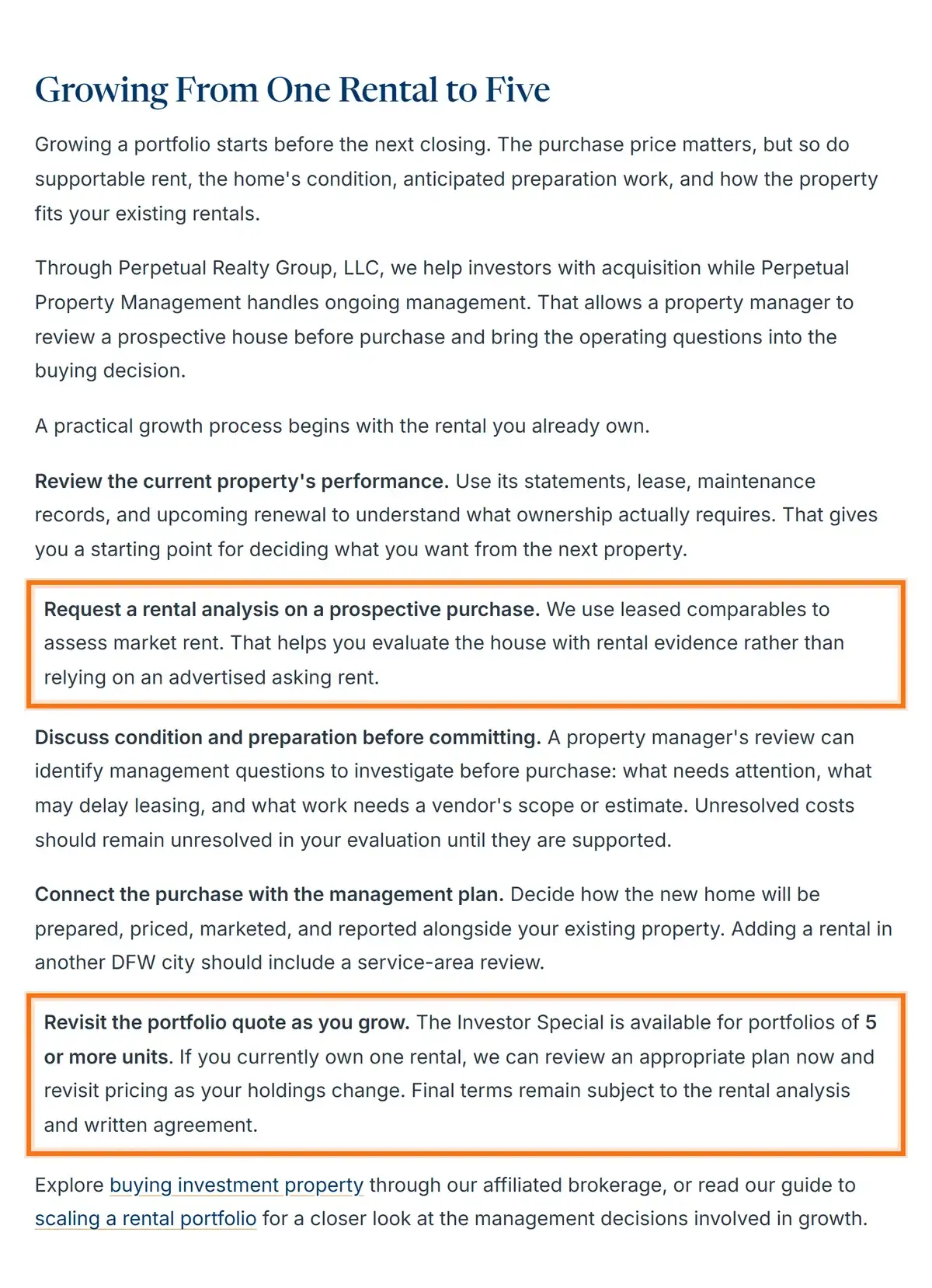
- Pricing: the Investor Special is 7% of monthly rent for portfolios of 5 or more units; if you own one rental now, we review a plan now and revisit pricing as your holdings change.
- Consistency: every adult screened against written criteria and Texas-compliant leases, so the process is the same across the portfolio.
Which plan applies to your package and every fee are confirmed in writing before you sign. To start, request a free rental analysis on the address you are considering or call 682-593-7033.
The takeaway: Before the next purchase, ask your manager for five things: per-property numbers on what you own, a rent range and a condition read on the target, a service-area check, and a plan review for the size your portfolio is becoming. Then make the buying decision with your lender and CPA, not with the manager.
Questions owners ask
Will a property manager give me investment advice?
It should not. A manager can give you operating records, a rent range from leased comparables and a condition read on a specific house. Whether to buy, how to finance it and how to hold it are decisions for you with a lender, a CPA and, for entities, an attorney. Be wary of anyone whose advice to buy is not backed by documents you can check.
Can one property manager handle rentals in different DFW cities?
Yes, if the manager actually serves those areas. Ask which cities and counties are covered and how a house outside them is handled before you buy there. For owners with several doors, we manage portfolios across Tarrant, Dallas, Collin and Denton counties and review a mixed-city portfolio as a package to confirm the scope.
Should I stagger lease end dates across my rentals?
It helps to know when each lease ends before you add another house, because two turnovers in the same month mean two make-readies and two vacancies at once. Renewal terms are the owner's decision; we begin renewals 120 days before lease expiration and check the rent against leased comparables, which gives time to plan around each end date.
Does management get cheaper as I add properties?
It can. As our price sheet notes, portfolio owners typically receive portfolio pricing, so ask for the whole fee schedule in writing, not just the monthly percentage, since placement and renewal fees apply per house. Our Investor Special is 7% of monthly rent for portfolios of 5 or more units, with its own placement, renewal, enrollment inspection and make-ready coordination terms on the price sheet.
How do I grow a rental portfolio one house at a time?
Start with the rental you own: read a year of its statements per property to see what it actually nets. For the next house, get a rent range from leased comparables, a condition read and vendor estimates for anything significant, and a written management quote, then make the financing and ownership decisions with your lender, CPA and attorney. Revisit the management plan as the count grows; our Investor Special begins at 5 units.
Can I get help managing my residential property portfolio in Tarrant County?
Yes. We manage portfolios of single-family homes, townhomes and small multifamily, with one management agreement, one owner portal and per-door reporting. Our home market is Northeast Tarrant County, and for owners with several doors we manage portfolios across Tarrant, Dallas, Collin and Denton counties. Final fees are set after a free rental analysis and confirmed in writing.
How do I choose a property manager that can scale with me?
Ask five questions: do I get per-property statements, can you review an address before I make an offer, which areas do you serve, how does pricing change as I add homes, and are screening criteria and leases the same at every address. Get the answers in writing and compare them with what each manager's site and agreement actually say.
Related services
Property management in Keller, North Richland Hills and Fort Worth. How full-service management works in Tarrant County →