Key takeaways
- There are three common setups: one named manager, departments, or a hybrid with one accountable name and a team behind it.
- The model matters less than the missing name. Ask who answers each kind of question, and who acts when that person is out.
- Texas Property Code 92.020 requires a landlord to give tenants a phone number for reporting emergencies. Who answers it is up to the company.
- Behind any setup, a licensed broker is responsible. TREC rule 535.2 makes the broker responsible for license-required property management by its sales agents.
- Test it before you sign: call the main number, email a two-part question, and time the answers.
Will you have one point of contact, or deal with different departments? It depends on the company. On a rental in Fort Worth, Keller or North Richland Hills you will meet one named manager who does everything, departments that each answer their own questions, or a hybrid. Each has a real cost, and what you are told on the sales call is not always what you get.
This guide covers how each setup works, what Texas law says about who a tenant must be able to reach, the questions that reveal who actually answers, and how to test a company before you sign.
Who answers what: a contact map to fill in before you sign
Here is how the three setups usually route the questions owners ask most, and what to get in writing whichever one a company runs:
| Your question | One named manager | Departments | What to get in writing |
|---|---|---|---|
| The rent is late | Your manager | Accounting or collections | A name, and when you will be told |
| A repair is over your approval limit | Your manager | Maintenance, then someone to approve | Who calls you, with what (description, photos, recommendation) |
| A tenant emergency at night | Your manager or an after-hours line | An emergency line or answering service | Who answers, and when you hear about it |
| A question about your statement | Your manager | Accounting | Where statements and invoices live (the owner portal) |
| A renewal or rent decision | Your manager | Leasing | That the decision is yours and when you get the recommendation |
| You disagree with an answer | The broker | A supervisor, often unnamed | The broker's name and how to reach them |
How to read this table: a good company can fill in every row with a name or a specific channel. Blank cells, or "the team", are where your calls will get lost. The last row matters most, because escalation is where the setups differ least in theory and most in practice.
One named manager: how it works and where it breaks
Under this model one person is assigned to your house. They recommend the rent, approve the listing, review applications, handle repairs and answer your email. When you call, the answer comes back with context: they know the tenant is up for renewal, that the water heater was replaced last spring, and that you prefer a text to a call. Decisions are faster because nobody hands anything off.
The breaks are predictable:
- Capacity. One person can only know so many houses well. Past that point you get a busy person rather than an informed one. How many properties a manager should handle covers what to ask.
- Absence. Vacation, illness and a day in court happen. Without a second person who can act on your house, the model has a hole for those days.
- Turnover. If the person leaves, what they knew leaves too, unless it was written down where you can see it.
A single contact without a documented backup is a single point of failure.
Departments: how it works and where it breaks
Under this model the company is organized by function. Leasing handles pricing, marketing, showings and applications. Maintenance takes repair requests and dispatches vendors. Accounting runs statements and disbursements. Your question goes to whichever desk owns it, and a different person answers each time. The strength is specialization and coverage: nobody's vacation stops your statement.
The breaks:
- You retell your story. Maintenance does not know the tenant is behind on rent; accounting does not know the repair was approved by phone.
- Nobody owns the outcome. When a problem spans departments, such as a repair dispute that turns into withheld rent, each desk does its part and the whole thing still goes wrong.
- Escalation is unclear. If the answer is "a supervisor" without a name, you do not have an escalation path.
The hybrid: one accountable name with a team behind it
Many well-run companies use a version of both: one accountable name on your account, the person who makes the judgment calls, and a team behind that person for volume work such as showings, statements and after-hours calls. The named person is who you call when a question does not fit a department.
The test of a real hybrid is simple: does the named person know what the team did this week? If maintenance sent a plumber and your manager hears about it from you, it is a department model with a friendly face. Ask how a work order reaches the person on your account, and how fast. A good answer names a system and a routine. A weak answer is "we communicate well."
What Texas law says about who must be reachable
Texas law does not tell a management company how to organize its staff, but three rules set a floor for who must be reachable:
- An emergency number for tenants. Property Code 92.020 requires a landlord with an on-site management office to provide a number answered 24 hours a day for reporting emergencies affecting health or safety, and requires every other landlord to provide tenants a telephone number for reporting those emergencies. The statute does not say who must answer it.
- Who manages the home. Under Property Code 92.201, a landlord must disclose the record owner and, if an off-site entity is primarily responsible for managing the home, the management company's name and street address, for example in the lease.
- A responsible broker. Under Occupations Code 1101.002, a person who controls the acceptance or deposit of rent from a resident of a single-family home for another, for compensation, is within the definition of a broker, and 1101.351 requires a license. TREC rule 535.2 makes the broker responsible for any property management activity by its sponsored sales agents that requires a license.
The practical point: whatever the org chart, there is a licensed broker who answers for the work. Ask for that name. You can check a license on TREC's license holder search. This is general information, not legal advice.
Answering service, call center or local team: what the phone line tells you
Many owners first meet a company through its phone line, and that line tells you a lot. A live answering service or call center can take a message at any hour, which is useful for a tenant reporting water on the floor at 2 a.m. What it usually cannot do is decide anything about your house. A local team member can, but only during the hours they work.
Neither is wrong; the question is what happens next. Ask any company:
- Who answers the main number during business hours, and who answers at night and on weekends?
- Can the person who answers at night dispatch a vendor, or only take a message?
- How does that call reach the person responsible for your house, and how fast?
- When do you, the owner, hear about it, and through what channel?
What separates a working setup from a frustrating one is the handoff: the night call ends up in the record for your house, the person responsible sees it, and you hear about anything that needs your decision. How emergencies themselves are handled is covered in after-hours emergencies in property management.
The questions that reveal who actually answers
Companies describe their model in the way that sounds best. These questions get past the description:
- "Who do I call about late rent?" You want a name, not a department.
- "Who approves a repair over my limit, and who tells me?" If two different people, ask how they talk to each other.
- "If my manager is out for a week, who acts on my house, with authority or just messages?"
- "How does a tenant reach someone at night, and does my manager see that call the next morning?"
- "If I disagree with an answer, who is above the person who gave it, by name?"
- "How many owners does my contact handle?" A number, then judge it against the service promised.
Write the answers down. Most of them will not be in the management agreement, so a short email confirming them is worth asking for. What to expect in how often you hear from a manager is in owner communication: what to expect.
Test the company before you sign
You can measure contact quality in a week with no commitment:
- Call the main number during business hours with a specific question. Note whether a person answers, how many transfers it takes, and whether you get an answer or a promise of a callback.
- Email a question that spans two functions, for example "if a tenant withholds rent over a repair, how do you handle it?" See whether one person answers the whole thing or two people answer halves.
- Ask for the sample management agreement and a sample statement, and time how long they take to arrive.
A company that is slow or fragmented while trying to win your business rarely improves after it has. The rest of the interview is in questions to ask a property manager; this section is only about contact, because contact is what you will experience every month.
What to expect, whichever setup you get
Whichever model a company runs, a few things are reasonable to expect and to confirm in writing:
- A named primary contact and a named backup, with their roles.
- A response time for owner questions, in business days, and what counts as urgent.
- One place where the record of your house lives: the owner portal, with statements, invoices and documents. The portal is the memory that survives staff changes.
- Proactive contact for what needs your decision: a repair above your limit, a renewal coming up, rent that is turning into a problem, an inspection with findings.
Quiet is not neglect when the statement and the portal already say everything is fine. Agree at the start how you will know things are fine, so a silent month does not feel like a missing manager.
What happens when your contact leaves
At some point the person who knows your house will not be there. Companies that handle this well have three things in place first: the portal holds the record, so the next person reads the history instead of relearning it; a backup already knows your house; and the broker responsible for the agreement is reachable.
Ask what happened the last time a manager left and how owners were told. A company that can describe the handover has done it. If everything about your house lives in one person's inbox, the handover will be rough however well-meant. If a manager has simply stopped answering, see when your property manager won't respond.
How Perpetual handles this
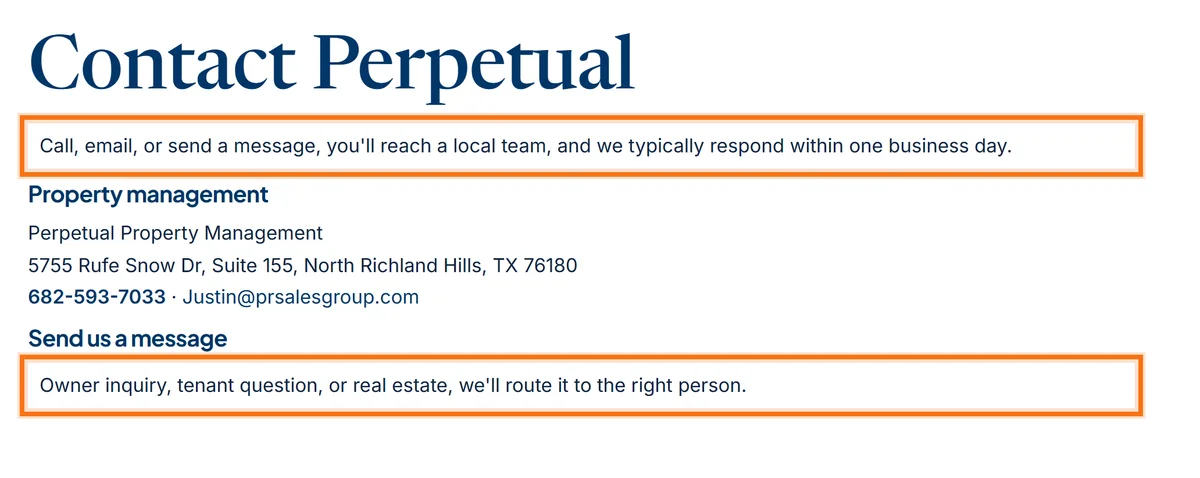
Perpetual Property Management is broker-owned: Justin Brown is a Texas broker and the owner (about Justin Brown), and our office is at 5755 Rufe Snow Dr, Suite 155, in North Richland Hills. We manage homes in Keller, North Richland Hills, Fort Worth and nearby. What our site states about contact:
- A local team. Our contact page says you will reach a local team, and that an owner inquiry, a tenant question or a real estate question is routed to the right person. We typically respond within one business day.
- A written promise. Our communication guarantee: we respond to your calls and emails within one business day, and while your home is vacant you get a written activity report every week, or that month's management fee is credited, subject to the Guarantee Addendum (the Perpetual Promise).
- Emergencies. Every plan on our price sheet includes 24/7 emergency response, and emergencies follow a 24/7 process.
- One record. Statements, invoices and documents are in the owner portal, and inspection photo reports go to your portal.
Who exactly handles your account day to day, who answers after hours, and how you hear about a night call are confirmed in writing before you sign. To test it yourself, contact us or call 682-593-7033 and see who answers.
The takeaway: Hire the company that can tell you by name who answers each question, who acts when that person is out, and where everything about your house is recorded, then check it by calling before you sign.
Questions owners ask
Will I have one point of contact or deal with different departments?
It depends on the company, so ask directly. Some assign one named manager for everything; others route questions to leasing, maintenance and accounting. Many combine the two: one accountable name who knows your house, with a team behind them. Ask who answers each kind of question, who acts when that person is out, and who answers at night.
Is a single property manager better than a team?
A single manager gives faster decisions and more context, as long as they are not stretched across more houses than they can know and there is a documented backup. A team gives coverage and specialization but makes you retell your story and can leave nobody owning the outcome. A named person with a team behind them and a complete portal record is the combination to look for.
Who should I call if my property manager is not responding?
The broker responsible for the company. A person who manages rentals for others for compensation generally needs a Texas broker license (Occupations Code 1101.002 and 1101.351), and TREC rule 535.2 makes the broker responsible for license-required property management by sponsored sales agents. Ask for the broker's name before you sign. If a manager has stopped responding altogether, read your agreement's termination terms before acting.
How quickly should a property manager respond to an owner?
Ask for the company's standard in business days for routine questions, and how it treats anything involving money, a tenant dispute or safety, and get it in writing. Then compare it with what you experienced during the sales period. At Perpetual, our written communication guarantee is a response within one business day.
Will I be notified every time something happens at my rental?
You should be told about anything that needs your decision or affects your money: a repair above your approval limit, a renewal coming up, rent that is becoming a problem, an inspection with findings. Routine events belong in the portal and the monthly statement rather than a phone call. Agree at the start that quiet means fine and the statement is the update.
Do property management companies use a phone answering service?
Some do, especially after hours, and some answer with their own staff. An answering service can take a message at any hour but usually cannot decide anything about your house. Ask who answers the main number during business hours and at night, whether that person can dispatch a vendor, and how the call reaches the person responsible for your house.
Does a Texas landlord have to give tenants an emergency phone number?
Yes. Property Code 92.020 requires a landlord with an on-site management office to provide a number answered 24 hours a day for reporting emergencies that materially affect health or safety, and every other landlord to provide tenants a phone number for reporting those emergencies. This is general information, not legal advice.
Related services
Property management in Keller, North Richland Hills and Fort Worth. How full-service management works in Tarrant County →